Investor Day Recap · WDAY
Workday puts addressable market at $276 billion, up from $188 billion, and targets ~$11 billion subscription revenue, 33%-plus margin for fiscal 2028
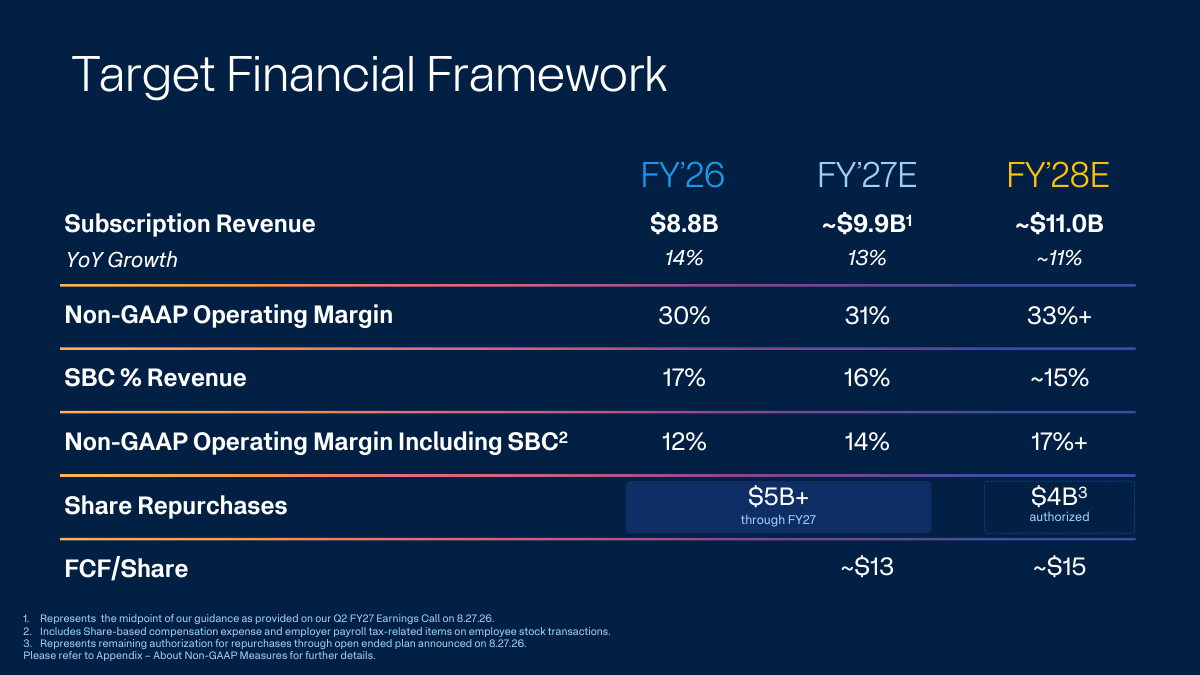
At its October 13, 2026 analyst day, Workday set a fiscal 2028 framework of about $11.0 billion in subscription revenue (~11% growth), a non-GAAP operating margin of 33% or more and free cash flow of about $15 a share. It put agentic AI ARR at about $600 million, expects AI to make up about 70% of incremental customer-base ARR in fiscal 2028, announced the acquisition of identity-governance company C1.ai, and declared its platform fully "headless" with agent-ready tools, Data Cloud and Agent Harness generally available.
In this recap17 sections
- Overview of Workday
- A fiscal 2028 frame: ~$11 billion subscription revenue, 33%-plus margin
- Addressable market set at $276 billion, with $100 billion from AI and platform
- Agentic AI ARR nears $600 million; AI to be ~70% of customer-base expansion
- Margin: flat headcount, a 2.5% reduction and "aggressive" internal AI targets
- C1.ai: Workday moves into identity governance
- Members from here
- "Fully headless": agent-ready tools, Data Cloud and Agent Harness go GA
- Sana Concierge and the shift from copilots to autopilots
- Go-to-market: Flex Credits, medium enterprise and the CIO buyer
For reference
- Key updates and announcements
- Financial targets
- New products, customer wins and partnerships
- Why management believes it can deliver
- Cash flow and capital allocation
- What wasn't said
- Q&A
- Sources
Overview of Workday
Workday describes itself, in its results for the fiscal 2027 second quarter ended July 31, 2026, as the enterprise AI platform for HR, finance and IT, serving more than 11,500 organizations worldwide, including more than 65% of the Fortune 500. In that release, filed with the SEC on August 27, 2026, the company reported total revenues of $2.649 billion, up 12.8% from a year earlier, and subscription revenues of $2.471 billion, up 13.9%. Operating income was $313 million, or 11.8% of revenues, and non-GAAP operating income was $824 million, or 31.1% of revenues. The release put 12-month subscription revenue backlog at $9.034 billion, up 14.2%, and total subscription revenue backlog at $27.403 billion, up 8.0%; operating cash flows were $520 million and free cash flows $460 million. Workday repurchased approximately 9.8 million shares for $1.3 billion in the quarter and held $3.403 billion in cash, cash equivalents and marketable securities at July 31, 2026, and its board authorized the open-ended repurchase of up to an additional $4.0 billion of Class A stock. CEO Aneel Bhusri said in the release that AI drove more than 25% of new ACV in the quarter and that more than 5,500 customers now use at least one of Workday's organic agents. CFO Zane Rowe guided in the release to fiscal 2027 subscription revenue of $9.940 billion to $9.950 billion, growth of 13%, and a fiscal 2027 non-GAAP operating margin of 31.0%.
A fiscal 2028 frame: ~$11 billion subscription revenue, 33%-plus margin
The deck's target financial framework shows fiscal 2028 subscription revenue of about $11.0 billion, growth of about 11%, a non-GAAP operating margin of 33% or more, share-based compensation at about 15% of revenue, a non-GAAP operating margin including SBC of 17% or more, and free cash flow of about $15 per share. For fiscal 2027 it shows subscription revenue of about $9.9 billion, 13% growth, a 31% non-GAAP operating margin, SBC at 16% of revenue, a 14% margin including SBC and free cash flow of about $13 per share, with the subscription figure the midpoint of the guidance given on the August 27, 2026 earnings call. CFO Zane Rowe said much of the framework had been discussed on that call, that "we're obviously holding to our guide this year," and that the 11% fiscal 2028 subscription growth figure had been mentioned then. Workday still believes there is some upside to the fiscal 2028 figure, tied to how customers adopt the agents it is building.
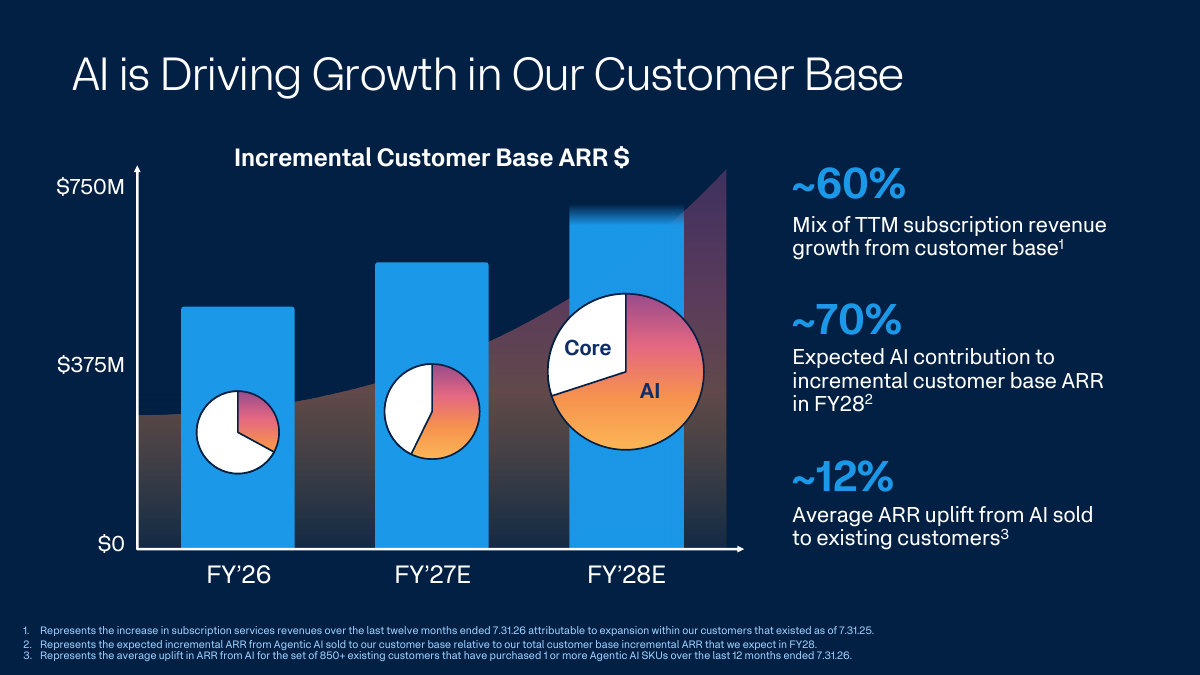
Three other figures framed the day. Workday now estimates its total addressable market at $276 billion, against a prior estimate of $188 billion as of September 16, 2025, split into $176 billion for HCM and financials and $100 billion for AI and platform. Annual recurring revenue from agentic AI is about $600 million, more than three times a year earlier. And Workday expects AI to account for about 70% of the incremental ARR it sells into its existing customer base in fiscal 2028, up from about half in the second quarter of fiscal 2027.
On capital return, the deck shows $5 billion-plus of share repurchases through fiscal 2027 and $4 billion of remaining authorization under the open-ended plan announced on August 27, 2026. Rowe said the $5 billion buyback announced a year earlier had been completed sooner than expected, with market conditions helping.
Addressable market set at $276 billion, with $100 billion from AI and platform
CFO Zane Rowe said the slide shown a year earlier carried $188 billion of TAM, that the HCM and financials portion had grown to about $176 billion through innovation and market growth, and that the $100 billion AI and platform opportunity is more than twice what it was last year. The estimate does not include ITSM or the C1.ai identity opportunity.
Aneel Bhusri, co-founder, CEO and chair, said customers are looking to Workday first for agents: "Our window is not forever, but we have a window, 12 to 18 months, where if we deliver our agents, we're going to be the default choice for our customers." Workday Data Cloud was not in his business forecast, and he said it could be a "huge new revenue accelerator".
Gerrit Kazmaier, president of product and technology, said he thinks the TAM opportunity is "much, much bigger" than the slide. His examples were employee service, where Sana Concierge already deflects more than 25% of HR cases and gives customers a productivity gain of around 20%, and finance, where he sees the opportunity in continuous controls on non-compliant spend and payroll errors rather than in shrinking the function. His framing of the economics: "AI assistant equals to software spend. Autopilot equals to labor spend."
Joel Hellermark, chief AI officer, said agents that execute whole workflows expand Workday's TAM "beyond the software budgets into the labor and services spend attached to that very workflow". Workday handled more than 400 million job applications on its platform last year, and he put the labor pool in recruiting alone at more than $100 billion.
Agentic AI ARR nears $600 million; AI to be ~70% of customer-base expansion
CFO Zane Rowe said Workday is approaching $600 million of ARR from its AI agents and portfolio, more than three times the figure shared a year earlier. Of Sana, Extend AI, HiredScore and Paradox, three are over $100 million of ARR and Sana is approaching that level. As of the second quarter, 300 customers had signed up for Flex Credits and more than 5,500 were using organic agents.
The existing customer base accounts for about 60% of trailing-12-month subscription revenue growth. In the second quarter AI became just over 50% of the incremental ARR mix sold into that base; Workday expects to end fiscal 2027 with more AI than core going into the base, and estimates roughly 70% of that selling motion will be AI-driven in fiscal 2028. Just under 900 customers bought at least one agent over the trailing 12 months, with an average ARR uplift of roughly 12% from that subset; the deck puts the set at 850-plus customers. New customers make up the other 40% of growth, with Workday expecting more than 75% of incremental new-customer ARR in fiscal 2028 to come from U.S. medium enterprise and international, and more than half of core net new deals in the July quarter including an agentic AI SKU.
Bhusri said Accenture is rolling out the self-service agent, priced on Flex Credits, to 400,000 employees, and that BMO is well along the same path. Four customers he met before the session were worried about the token cost tied to agents, which he took as a sign they want to use them. He described Workday as "catching a tiger by the tail," with 17 agents that are all young and no date for when they take off. He called the consumption model for agents, APIs and Data Cloud "a beautiful model" and a flywheel, new to Workday and to how investors look at it.
Margin: flat headcount, a 2.5% reduction and "aggressive" internal AI targets
Aneel Bhusri, co-founder, CEO and chair, said: "I don't personally think about running the business for margin. I think about running it for growth." Workday just did a reduction of 2.5% of the company, which he said was about removing layers, in some places 10 between him and an engineer, rather than cost: "I promise you it wasn't for cost cutting." Workday will set what he called pretty aggressive margin targets to force use of AI tools internally, and the benefit may come from not hiring in areas it hired in before rather than further reductions.
CFO Zane Rowe said Workday has kept headcount relatively flat through the year and is running a company-wide review of people, process and systems. The deck says Workday plans to deliver operating margin expansion in fiscal 2028 through internal AI usage and those efficiencies. Rowe said SBC as a percentage of revenue should be roughly 15% next year and decline beyond fiscal 2028, and that Workday will start talking more about non-GAAP operating margin including SBC, expected above 17% next year.
C1.ai: Workday moves into identity governance
CFO Zane Rowe called C1 the big announcement of the day. Aneel Bhusri, co-founder, CEO and chair, said HR systems are the source of identity and Workday sits upstream of identity providers; with C1, Workday adds a layer that governs both humans and agents. It will take time for the market to realize and for Workday to ramp sales, but he expects it to be "very disruptive to the identity space".
Gerrit Kazmaier, president of product and technology, said identity is "comically broken," with delays between hiring and provisioning access, and that C1 is built around task-based rather than human identity, which lets it permission AI requests contextually in real time. He cited estimates that agents will outnumber humans 50 to 100 to one within two or three years.
Gabe Monroy, CTO, said a small survey found 70% of customers want HCM and identity governance in one system. He cited projections of non-human identities rising from about 50 to about 70 per human identity. Rob Enslin, chief commercial officer, said the CIO is emerging as a distinct buying center and that C1.ai opens a broader opportunity there. No purchase price, terms or closing timetable were given.