Investor Day Recap · VEEV
Veeva raises life sciences TAM to $30 billion on AI, keeps $6 billion 2030 run-rate goal, sets 10% Vault AI pricing
Veeva put its addressable market at $30 billion, up $10 billion from a year ago, and said it remains on track for a $6 billion revenue run rate by calendar 2030, a goal it said does not depend on its new AI products. It priced Vault AI at a flat 10% of a customer's Vault subscription, said Falcon agents will be licensed per agent, set a Spring 2027 Study Suite launch aimed at CROs, and said it expects to meet or exceed third-quarter guidance.
In this recap16 sections
- Overview of Veeva Systems
- A $30 billion market and an unchanged $6 billion goal
- Vault AI at 10% of the Vault fee; Falcon licensed by the agent
- Study Suite, IQVIA and the CRO channel
- Members from here
- Vault CRM at halftime; UCB commits globally
- Quality Cloud to be reported separately
- Services above $600 million, a 35% margin floor
- Aspen, Veeva Basics and two customers
For reference
- Key updates and announcements
- Financial targets
- New products, customer wins and partnerships
- Why management believes it can deliver
- Cash flow and capital allocation
- What wasn't said
- Q&A
- Sources
Overview of Veeva Systems
Veeva Systems builds what it calls the industry cloud for life sciences: applications, AI agents, data and business consulting sold to biopharma and medical device companies, from the largest pharmaceutical companies to emerging biotechs. The company is organized as a Public Benefit Corporation and, in its results for the quarter to July 31, 2026, said it serves more than 1,500 customers. In that release, Veeva reported total revenues of $928.0 million, up 18% year over year, and subscription revenues of $766.8 million, up 16%; subscription revenues comprised $347.4 million from Veeva Commercial Solutions and $419.4 million from Veeva R&D and Quality Solutions. Operating income was $275.0 million and non-GAAP operating income was $415.9 million, with non-GAAP fully diluted net income per share of $2.35. The same release said Veeva acquired Copli in the quarter, and CFO Brian Van Wagener said in it that second-quarter results exceeded guidance on all metrics. For the fiscal year ending January 31, 2027, the release guided to total revenues of $3,682 million to $3,687 million, non-GAAP operating income of about $1,640 million and non-GAAP fully diluted net income per share of approximately $9.21.
A $30 billion market and an unchanged $6 billion goal
Peter Gassner, Veeva's founder and CEO, said the company now sizes its life sciences opportunity at a $30 billion total addressable market, up from $20 billion a year ago, a change he said is "largely because of AI." The $6 billion revenue run rate goal for calendar 2030, set in 2024, was left as it was, and Veeva said it is on track to reach it.
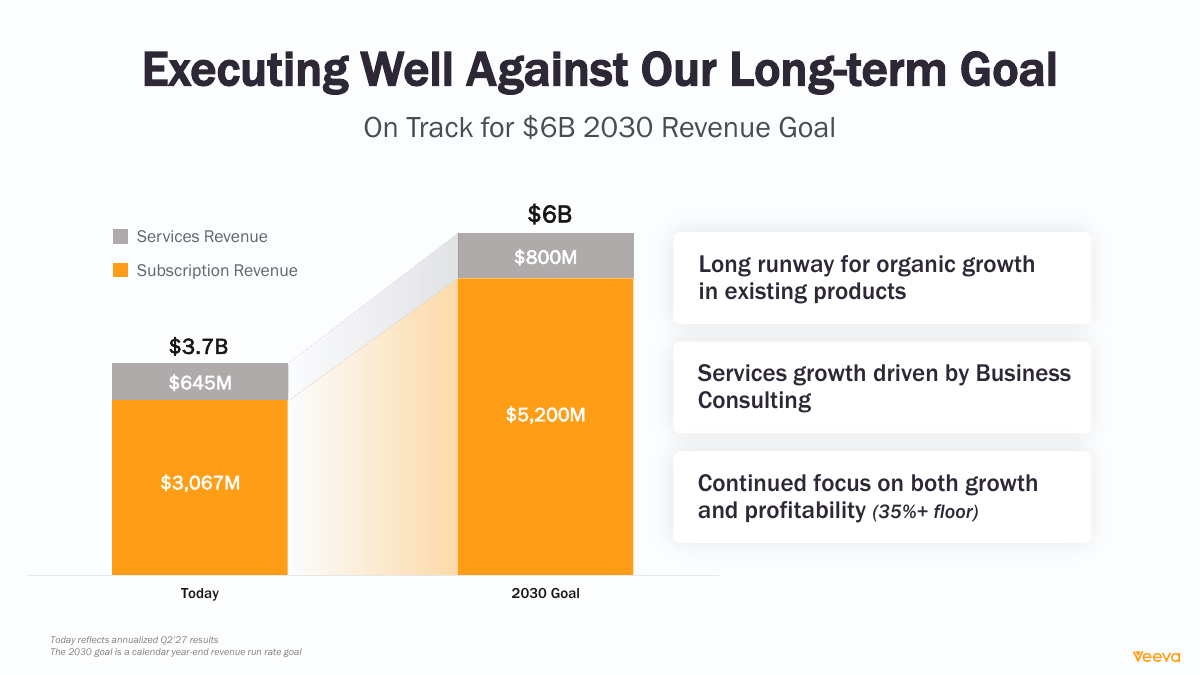
Brian Van Wagener, CFO, said Veeva ended its second quarter at roughly a $3.7 billion revenue run rate, that the 2030 goal corresponds to roughly fiscal 2031, and that the goal was built bottom-up on the products Veeva had two investor days ago. He said Veeva is not dependent on Falcon, Vault AI or Aspen to reach it and is not yet putting a financial target on those businesses. "It's not a CAGR, it's not a forecast," Van Wagener said of the $6 billion figure, adding that annual guidance serves that role and that some years on the path will be slower or faster. On the gap between a larger TAM and an unchanged goal, he said the goal does not change just because Veeva is building and innovating.
Nearer term, Van Wagener said Veeva expects to meet or exceed its prior guidance on all metrics for the third quarter, which ended October 31, 2026, and will report full results and updated fiscal 2027 guidance on its December 3 earnings call. That guidance, issued August 26, 2026, called for total revenue of $932 million to $935 million, non-GAAP operating income of $417 million to $420 million and non-GAAP fully diluted net income per share of $2.33 to $2.34. Fiscal 2027 guidance calls for non-GAAP operating income of $1.64 billion, a bit more than double five years ago, which Van Wagener said implies margins of about 44%, roughly flat year over year.
Van Wagener said 97% of revenue comes from life sciences, with about 70% from the top 20 biopharmas and enterprise customers, all of which use at least one Veeva product. At 12% penetration of the $30 billion TAM, he said Veeva has a long runway; just under half of the TAM is Development Cloud, about 20% is quality and 35% is commercial.
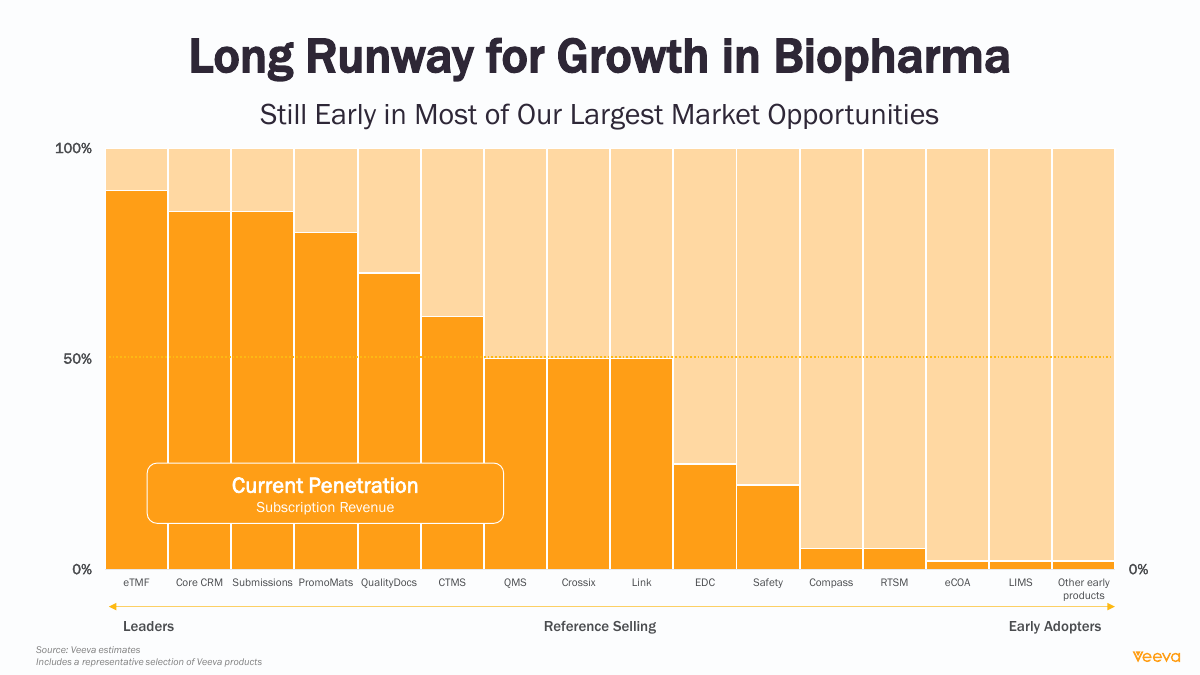
The products Veeva calls leaders generally have more than 50% penetration and grow at a lower rate as they mature, while scaling products such as Crossix, Link, Safety, EDC, Compass and RTSM are growing quickly with room left, and the early growth products sit at the far right of the chart. Collectively, Van Wagener said, the major growth products are much larger than the leader products.
Vault AI at 10% of the Vault fee; Falcon licensed by the agent
Gassner laid out two AI offerings: Vault AI, which helps users do the work inside Vault applications, and Falcon, agentic labor that does the work for them. Vault AI is optional, available today, and priced at 10% of the customer's Vault subscription fee for that Vault, with unlimited use. Gassner said the model was introduced a month or so ago, that flat pricing gives Veeva an incentive to be efficient with tokens, and that Vault AI ships on a two-week release cycle against roughly four months for the validated applications.
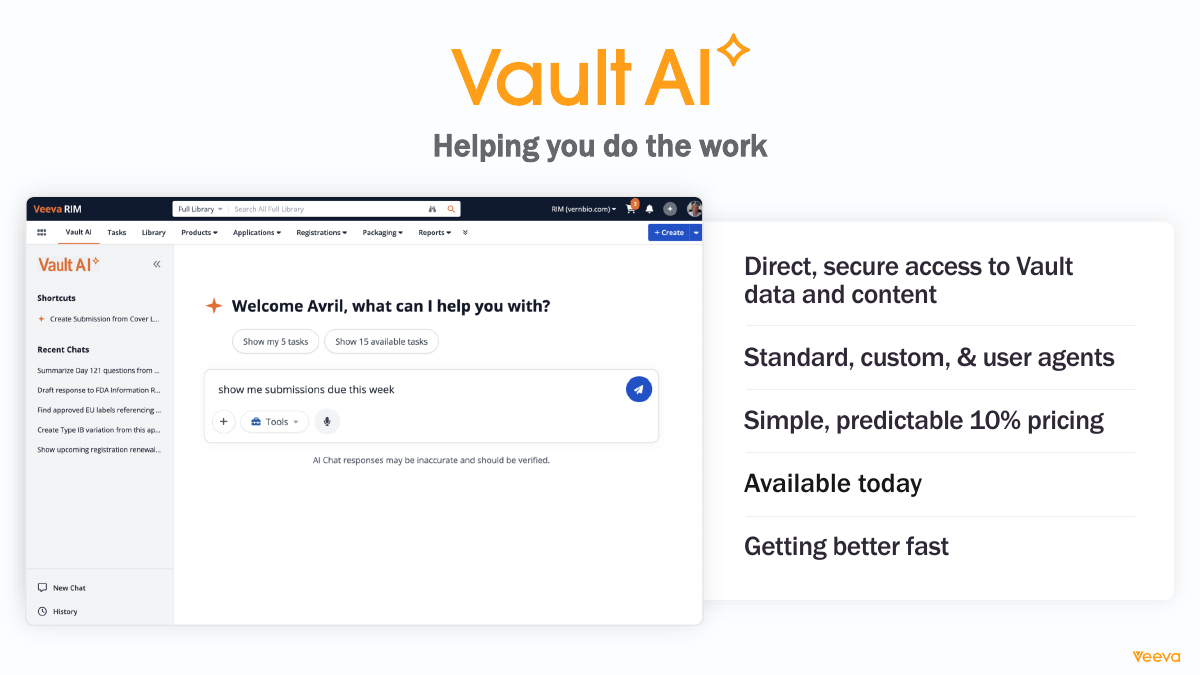
Asked how Veeva arrived at 10% when much of the industry is moving to token, consumption or outcome pricing, Gassner said "we don't like to follow the herd," that customers want AI that is optional, predictable and valuable, and that Veeva is fairly sure it can keep cost of goods sold quite a bit under 10%. He said Veeva does not try to maximize price on any one thing because doing so harms the customer relationship over the long term. He also said Veeva will not charge extra for agents or other systems accessing Vault through its MCP server or the coming Vault command line interface.
Falcon, started in 2026, is run by a self-contained team reporting directly to Gassner, with a different development, presales, support and validation motion from the applications business. Licensing is one flat annual fee per agent, set by capability rather than tokens, and priced differently for a top 20 biopharma than for an emerging biotech; Veeva supplies the computing and the models. In the Q&A, Gassner gave the example of the clinical intake agent: a seven-figure deal for a top 10 biopharma versus perhaps a $100,000 deal for a very small biotech.
Gassner said Falcon could be adopted faster than applications because there is no implementation, integration or data migration, but cautioned, "I think they could go faster, but I don't want anybody to get too over their skis on this." The current focus is customer success with early adopters rather than revenue. The agent furthest along is MLR in commercial, part of which came through a small acquisition earlier in 2026 and which already has early adopters live; clinical intake, which files and tags trial documents, is also with early adopters. The deck lists agents in development in clinical, regulatory, safety and commercial, with more under consideration, and Gassner said quality will follow.
On 2027, Gassner declined to give projections but said the Falcon pipeline includes deals measured in seven figures and others in six figures. "Next year, I think we're going to have solid subscription value-based baked-in long-term revenue, but we're not ready to size that yet," he said. Van Wagener said it is too early to talk about Falcon margins specifically and that Veeva does not expect a material impact in the short term.
Veeva uses foundation models from Anthropic and others for reasoning inside Falcon and Vault, and Gassner said that over the past six months the models have reached the level of reasoning Veeva needs, with the value sitting in the applications, agents and "harness" above them. He said Veeva does not see the model companies as competition at this time, citing roughly 8,000 people working across applications, data, consulting and Falcon.
Study Suite, IQVIA and the CRO channel
Gassner said Veeva Study Suite, planned for Spring 2027, is meant to let CROs offer sponsors the full set of applications to run a trial and pass them through to small biotechs. He called the CRO channel "well over a billion-dollar opportunity" in EDC, eCOA and RTSM alone, because almost half of trials are outsourced, an area Veeva had not focused on, and said Veeva is hiring a dedicated team for it. In the Q&A he said that opportunity was already inside the TAM but had not been pursued, partly because Study Suite would not work well unless the CRO also runs Veeva's clinical operations suite, which many CROs now do.
The recently announced IQVIA partnership fits this: Gassner said IQVIA, which he described as the largest CRO running more than 2,000 trials at a time, will move its core clinical operations applications, eTMF, CTMS and Site Connect, live on Veeva for all new studies in just seven months. He said that work would have taken about 14 months two years ago, and that IQVIA had not been a clinical customer because a legal dispute rooted in the commercial side, roughly two years ago, prevented business until it was resolved. Asked about channel conflict between Falcon and CROs, Gassner said there has been none: CROs make their money on high-value services and want commoditized work automated. On contract structure, clinical operations applications are a fixed capability the CRO bears as its own cost, while clinical data applications are normally passed through to the sponsor because requirements vary by study.
Veeva also described a Clinical Network connecting sites running SiteVault and their EHR systems to sponsors, with a new eSource application moving data from site records directly into EDC.