Investor Day Recap · SMTC
Semtech sets a $3.2 billion fiscal 2030 revenue framework, $2.1 billion of it data center, and raises its third-quarter outlook
Semtech used its Data Center Analyst Day to set a fiscal 2030 framework of $3.2 billion in revenue, a 38% compound rate from fiscal 2026, with data center revenue compounding 75% to $2.1 billion, adjusted gross margin of 70% and adjusted EPS of $12.40 to $13.00. It raised its third-quarter fiscal 2027 outlook to $417.5 million of revenue and $1.14 of adjusted EPS, and expects data center revenue to more than double in fiscal 2027 and again in fiscal 2028.
In this recap15 sections
- Overview of Semtech
- A $3.2 billion fiscal 2030 framework anchored on data center
- Third-quarter outlook raised; 64% gross margin called a floor
- The data center case: a $15 billion SAM and ten times the content per module
- Members from here
- Panel: networking's slice of data-center spend set to rise
- Balance sheet repaired, R&D up 27%, SG&A up 8%
- LoRa: from a $150 million plateau to $250 million-plus
For reference
- Key updates and announcements
- Financial targets
- New products, customer wins and partnerships
- Why management believes it can deliver
- Cash flow and capital allocation
- What wasn't said
- Q&A
- Sources
Overview of Semtech
Semtech describes itself, in its results for the quarter to July 26, 2026 (the second quarter of fiscal 2027), as a provider of high-performance semiconductors powering AI data center networking and connected Internet of Things devices worldwide, serving the infrastructure, industrial and consumer markets. In that release the company reported net sales of $341.9 million, which it called a record, up 17% sequentially and 33% year over year, with a GAAP gross margin of 53.8% and a non-GAAP adjusted gross margin of 54.5%. The release reported a GAAP operating margin of 16.3% and an adjusted operating margin of 24.4%, GAAP diluted earnings per share of $1.59 and adjusted diluted earnings per share of $0.71, and free cash flow of $61.4 million for the quarter. By segment, the release reported net sales of $126.2 million for Signal Integrity, the group whose general manager, Imran Sherazi, presented the data center business at the event, at a segment gross margin of 65.3%; $117.4 million for Analog Mixed Signal and Wireless; and $98.3 million for IoT Systems and Connectivity, of which $48.1 million came from the cellular module business classified as held for sale. CEO Hong Hou cited "accelerating bookings and record backlog" in the release, and CFO Mark Lin said the company entered the third quarter expecting broad-based bookings to translate into revenue, margin and earnings growth. The release's outlook for the third quarter of fiscal 2027 was net sales of $410.0 million plus or minus $5.0 million and adjusted diluted earnings per share of $1.05 plus or minus $0.03.
A $3.2 billion fiscal 2030 framework anchored on data center
Mark Lin, EVP and CFO, set out a framework under which Semtech expects revenue to grow at a 38% compound annual rate from fiscal 2026 to fiscal 2030, reaching $3.2 billion, on a base that excludes $166 million of fiscal 2026 revenue from the cellular module business it expects to divest in the fourth quarter. Data center revenue is to compound at 75% to $2.1 billion in fiscal 2030, and Semtech expects it to more than double in fiscal 2027 versus fiscal 2026 and more than double again in fiscal 2028. LoRa revenue is expected to compound at 30% through fiscal 2030, with steady growth from the rest of the portfolio above market rates. Semtech also targets a 70% adjusted gross margin in fiscal 2030, an adjusted operating margin of 48% to 50% with R&D investment as the primary variable, free cash flow at 35% of revenue, and adjusted diluted EPS of $12.40 to $13.00, a 64% to 66% compound rate, assuming a 20% non-GAAP tax rate and 104 million weighted average diluted shares.
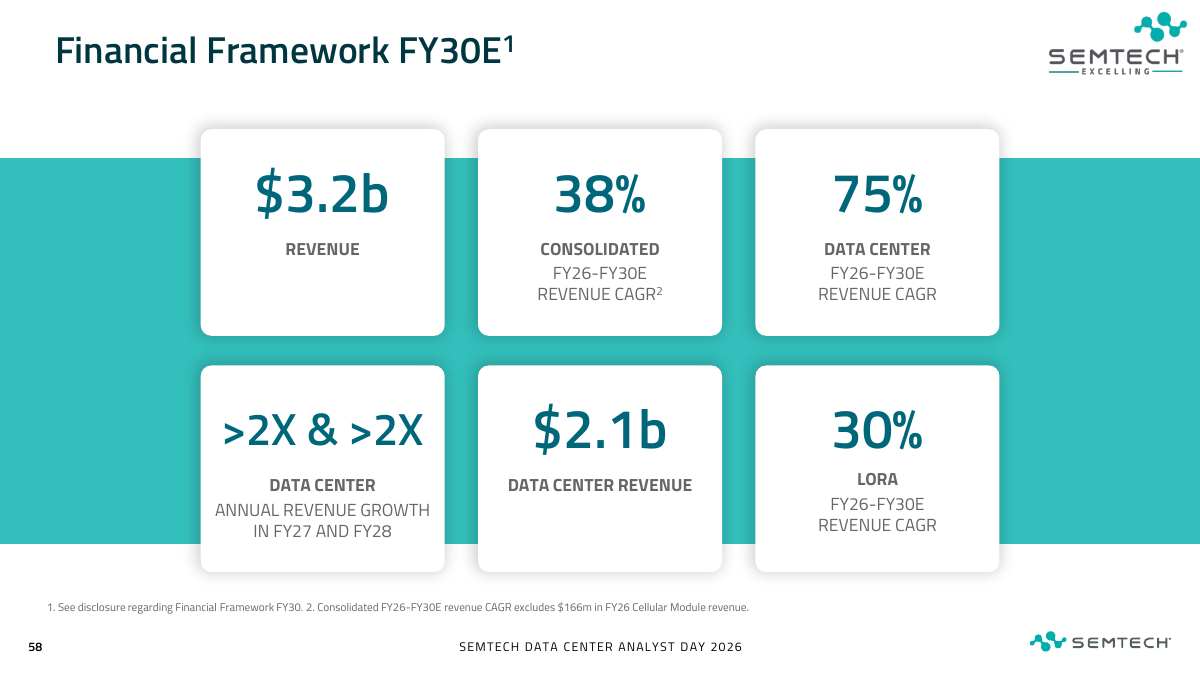
Hong Hou, president and CEO, translated the rates into multiples: a 75% compound rate means about 9x data center revenue in four years, 30% means nearly 3x for LoRa, and the consolidated company about 3.5x. He said the projection is "heavily, heavily indexed on the near term" where the company has visibility, with data center growth of over 100% year over year expected in fiscal 2027 and fiscal 2028, and the market's compound growth rate used for the rest of the horizon, against which Semtech aspires to grow 50% faster than the market. Hou said record-level backlog gives visibility for many years and makes this the right time to provide multi-year financial guidance. The deck describes the fiscal 2030 framework as targets and goals, not guidance or forecasts.
Asked by an analyst about the deceleration implied in the final two years, Lin said the outer-year rates are grounded in market CAGR assumptions while fiscal 2027 is grounded in backlog and fiscal 2028 in backlog plus design wins that have yet to ramp, so that if the market grows faster than presented, Semtech's growth rates would expand beyond what was shown. Hou added that the framework does not reflect any sensed deceleration; the near years simply have backlog behind them, and the company will update as it goes.
Third-quarter outlook raised; 64% gross margin called a floor
Lin updated the outlook for the third quarter of fiscal 2027 "to the upside," with revenue of $417.5 million at the midpoint against a prior $410.0 million, which would be 56% growth year over year. The adjusted gross margin midpoint moved to 59.0% from 58.3%, and to 64.0% from 63.9% excluding the held-for-sale cellular modules business. The adjusted operating margin midpoint is 33.0%, which Lin called a record, against a prior 31.0%, and adjusted diluted EPS is $1.14, also called a record, against a prior $1.05, up 138% year over year. Semtech continues to expect the cellular modules divestiture to receive regulatory clearances and close in its fourth quarter.
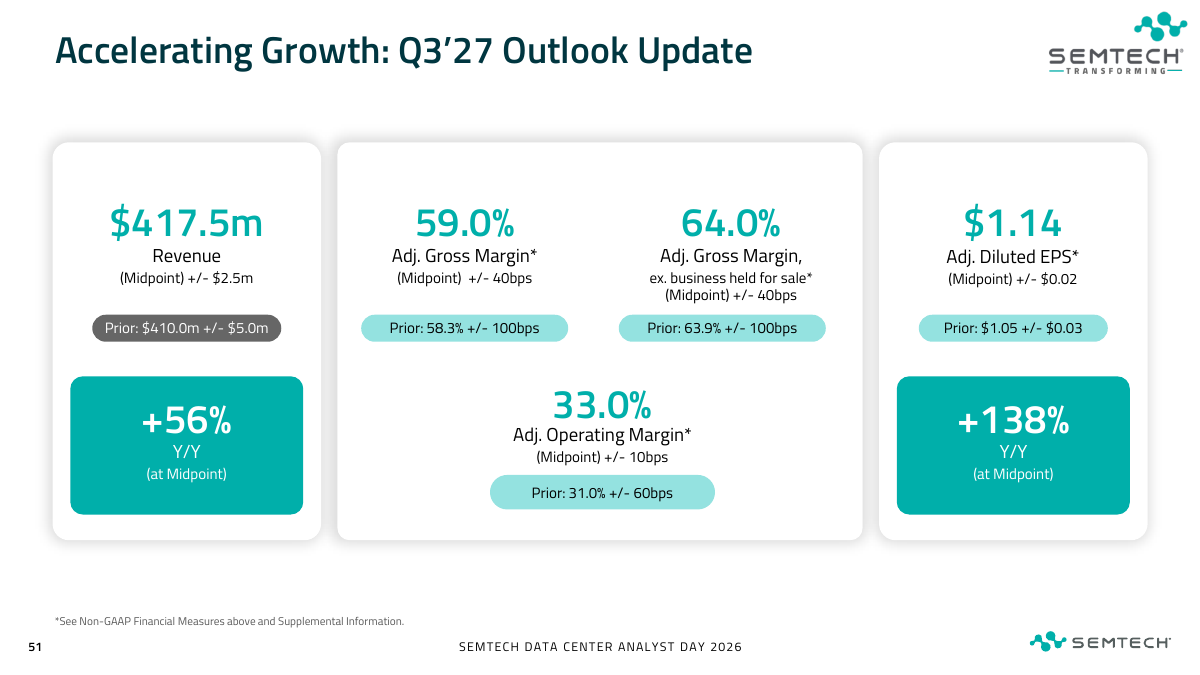
Hou said it took a year to grow revenue by mid-teens percent from the third quarter of fiscal 2025 to the third quarter of fiscal 2026, but the updated guidance implies over 50% growth from the third quarter of fiscal 2026 to the third quarter of fiscal 2027. After the divestiture closes, he said, the gross margin baseline will be 64%, which he described as a floor rather than a ceiling, with a mix-shift tailwind into higher-margin business. "This is not just a projection. This is the data. This is the fact," Hou said of the inflection.
In fiscal 2024, data center and LoRa each made up about 7% of revenue; in the third quarter of fiscal 2027, excluding cellular modules, data center is expected to be 40% and LoRa 19%. In dollars, data center revenue was $61 million for all of fiscal 2024 and is expected at $145 million in the single third quarter of fiscal 2027; LoRa was also $61 million in fiscal 2024 and is expected at $68 million in the quarter. Lin said both are at record levels and carry among the company's highest gross margins, which is the basis for its belief that gross margin can rise beyond 64%. The deck shows a longer-term target of 65% of revenue from data center, and Hou said data center should be about two-thirds of a much larger total by fiscal 2030. The six points from 64% to 70% come from mix, with data center and LoRa growing, and from scale. In the Q&A, Lin called 70% "less of a bogey and more of a target," with the mix shift the main driver and scale a contributor.
Adjusted gross margin rose 410 basis points over the eight quarters from the second quarter of fiscal 2025 to the second quarter of fiscal 2027, and Semtech expects a 950-basis-point step in the single quarter to the third quarter of fiscal 2027, excluding cellular modules; adjusted operating margin rose 1,020 basis points over those eight quarters and is expected to add 860 basis points in one quarter. Adjusted EPS went from $0.11 to $0.71 over the eight quarters and is expected at $1.14. Adjusted operating expense is pegged at 26% of revenue at the midpoint, down 910 basis points from fiscal 2025.
The data center case: a $15 billion SAM and ten times the content per module
Hou said the serviceable market, taken from 650 Group data and adjusted to Semtech's products and organic roadmap rather than the whole market, can grow about 5x in four years. The deck puts it at $3 billion in fiscal 2026 rising to $15 billion in fiscal 2030, a 50% compound rate. Semtech sees three avenues for growth: riding the market, raising content per module by a potential 10x, and gaining share as it did with its 800G TIA. The deck shows roughly $8 of content per 800G module today, rising to more than $100 per module at 3.2T as a CW laser, photodiode and modulator join the TIA and driver. Asked how much of that content gain is in the $2.1 billion, Hou said "a very moderate amount," not close to what the company believes the potential is.
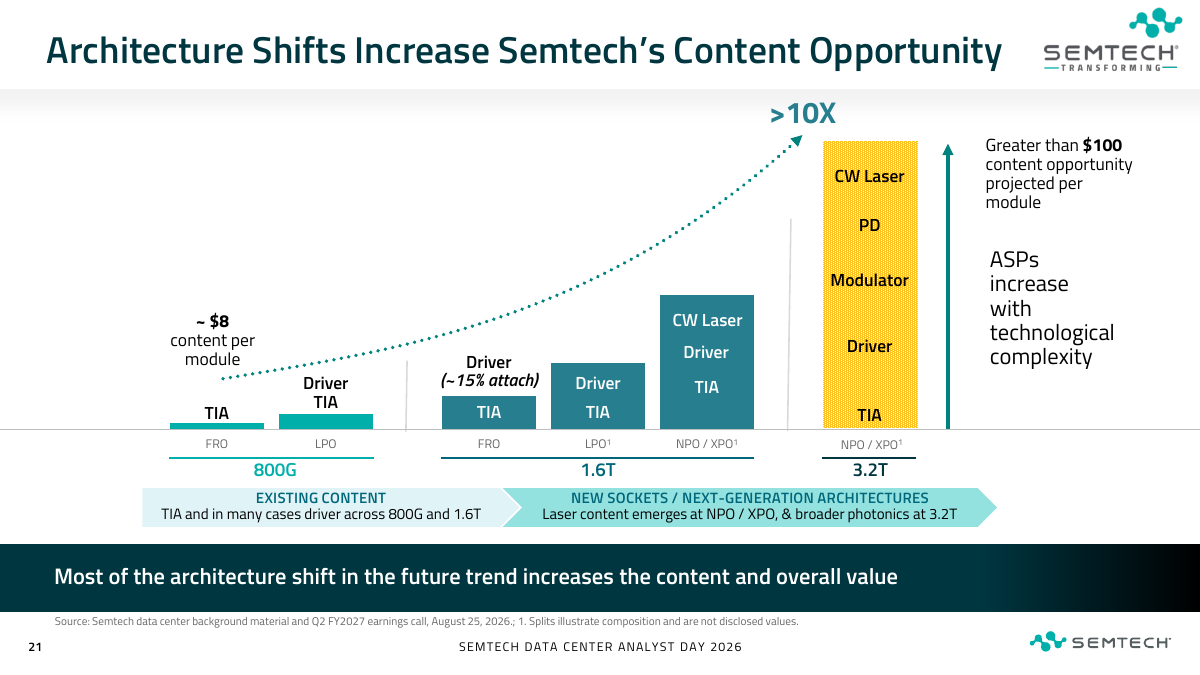
Imran Sherazi, who runs the signal integrity products group, said Semtech partnered with a major AI supplier to prove redrivers at 224 gigabits, adding 20 dB of link budget, and is shipping that solution in volume. Its 336-gigabit redriver, he said, had just been found to be the only one of six competitive redrivers currently performing in an AI data center application, at less than a tenth of the power of a retimed solution. His rule for the data center is "linear when you can and retimed when you must". On FiberEdge, Semtech took its share of 100G-per-lane TIAs from 18% to more than 50%, and 200G shipments have only just begun, forming the base for 1.6T modules and then NPO, XPO and other integrated form factors. The photonics lasers deliver 44% power conversion efficiency against a typical 30% and under 0.8 dB of coupling loss against 1.2 to 1.5 dB, saving 40 to 50 milliwatts in an 800G module. In an illustrative 200,000-GPU data center with one optical module per link end, Sherazi counted 500,000 modules, 800,000 TIAs and 800,000 drivers. Semtech expects to more than double data center revenue this year and again next year, and to outgrow the SAM to reach $2.1 billion by fiscal 2030.
Hou said the photonics assets came from two acquisitions, HieFo in March 2026 and D-Tech in June 2026. Demand already exceeds capacity, and Semtech plans to raise capacity three to four times by the end of this year, partly through the 7,000-square-foot cleanroom that came with D-Tech. It plans to demonstrate 200G and 300G photodiodes at OFC 2027. Hou said Semtech will not compete with commodity lasers at about $3 per 30-milliwatt part; its strategy starts with gain chips for tunable lasers in scale-across, moves into coherent-lite lasers now in customer qualification, selectively serves transceivers with very-high-power 150- to 250-milliwatt CW lasers so one laser can serve eight channels, and develops lasers for optical compute interconnect and CPO scale-up. Semtech does not make DSPs and does not plan to, as the market moves toward DSP-less links in scale-up and scale-in.
On architecture, Hou told analysts not to put a terminal value on copper yet, since copper plays in 224-gigabit racks and more so at 448 gigabits. He described NPO as a densely packed form of LPO that delivers about 85% of CPO's power savings while leaving the socket open, with NPO volume starting around the end of next year and CPO coming after it. He said he had counted 15 to 20 NPO demos at the OCP summit the day before, and that the market is moving toward analog solutions. Semtech announced a multi-year strategic agreement with Tower Semiconductor earlier in the week of the event that Hou said secures capacity across the forecast horizon. Sherazi said the Tower agreement supports the financial plan beyond fiscal 2030 and noted the two companies have worked through seven generations of process technology since 2002. Semtech now co-plans monthly with more than 20 customers.