Investor Day Recap · P
Everpure sets preliminary FY28 outlook of $7.0–7.3 billion revenue and $1.7–1.9 billion operating income, targets Rule of 40 through FY30
At its September 23, 2026 analyst meeting, Everpure gave a preliminary fiscal 2028 outlook of $7.0 billion to $7.3 billion of revenue, up 39% to 45%, and $1.7 billion to $1.9 billion of non-GAAP operating income. The company reiterated fiscal 2027 guidance, set a Rule of 40 range of about 50 to 70 through fiscal 2030, said new-market revenue should reach about 20% of the total by fiscal 2030, and sized its addressable market at $207 billion.
In this recap17 sections
- Overview of Everpure
- A preliminary fiscal 2028 outlook: $7.0 billion to $7.3 billion of revenue, operating income up 80% to 100%
- A Rule of 40 reset through fiscal 2030, with new markets at about 20% of revenue
- A new disclosure: "Core + Core AI" against "New Revenue"
- Addressable market sized at $207 billion by 2030
- Component costs up 153% since Q3 FY26, and share gains through every NAND cycle
- Members from here
- The core: eight quarters of accelerating growth and "franchise" wins
- Hyperscale: two design wins, firm commitments through fiscal 2028, interest beyond the top five
- Scale AI and modern data software: the other two new markets
For reference
- Key updates and announcements
- Financial targets
- New products, customer wins and partnerships
- Why management believes it can deliver
- Cash flow and capital allocation
- What wasn't said
- Q&A
- Sources
Overview of Everpure
Everpure, the former Pure Storage, sells all-flash data storage systems and the Purity software that runs them, along with subscription and storage-as-a-service offerings, to roughly 15,000 customers, including 64% of the Fortune 500. Rob Lee, chief technology and growth officer, said the rebranding and name change were meant to make it "very optically obvious that we are doing much more than just data storage". Management groups the business into a core enterprise storage business (FlashArray, FlashBlade and Evergreen//One, including GPU-attached "Core AI") and three new markets: modern data software, scale AI storage for neoclouds, and DirectFlash-based hyperscale solutions. In its results for the second quarter of fiscal 2027, the quarter ended August 2, 2026, released on August 26, 2026, Everpure reported revenue of $1.2 billion, up 38% year over year, with product revenue of $687 million, up 54%, and subscription services revenue of $499 million, up 20%. The release reported subscription ARR of $2.1 billion, up 20%, remaining performance obligations of $4.1 billion, up 44%, GAAP operating income of $63 million and non-GAAP operating income of $230 million, a non-GAAP operating margin of 19.4%. It reported operating cash flow of $(136) million, free cash flow of $(238) million, $1.0 billion of cash, cash equivalents and marketable securities, and about $69 million returned to stockholders through repurchases of 0.9 million shares. In the same release the company raised fiscal 2027 guidance to revenue of $5.03 billion to $5.07 billion, 37% to 38% growth, and non-GAAP operating income of $940 million to $960 million, from prior guidance of $4.41 billion to $4.51 billion and $820 million to $860 million, with CFO Tarek Robbiati citing "historic industry price increases in the first half of FY'27." The release also noted a design win with a second top-five hyperscaler, announced August 10, 2026.
A preliminary fiscal 2028 outlook: $7.0 billion to $7.3 billion of revenue, operating income up 80% to 100%
Tarek Robbiati, CFO, gave a preliminary outlook for fiscal 2028 of $7.0 billion to $7.3 billion of revenue, implying growth of 39% to 45% on top of the 37% to 38% growth guided for fiscal 2027. Everpure expects fiscal 2028 non-GAAP operating income of approximately $1.7 billion to $1.9 billion, growth of roughly 80% to 100% from fiscal 2027, which equates to a non-GAAP operating margin of 24% to 26%. The deck puts the fiscal 2026-to-fiscal 2028 revenue CAGR at 38% to 41% and the operating income CAGR at 64% to 73%, with 7 to 9 points of margin expansion over the two years. The outlook is "well above historical levels and current consensus," Robbiati said.
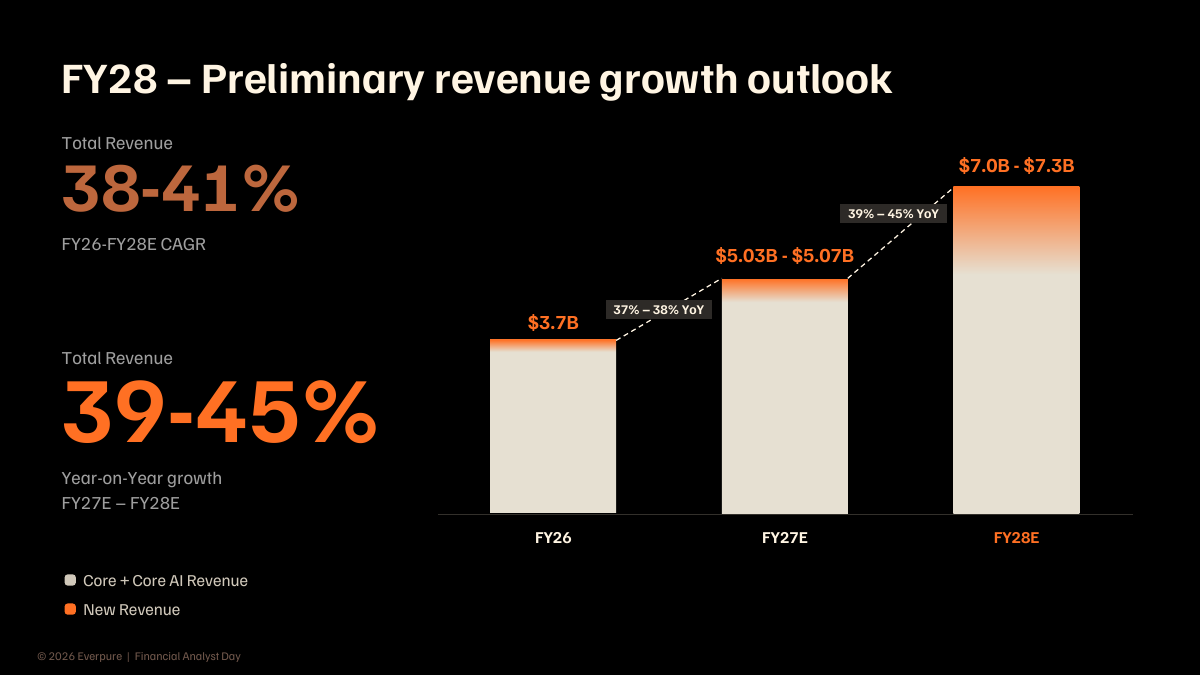
He was explicit about what the numbers are not: "So this is not guidance, but it's preliminary outlook," he said, adding that formal fiscal 2028 guidance will come at the usual timing as fiscal 2027 closes, and that the range is wide because the company is in the middle of its planning cycle and will come back with a narrower one. Robbiati walked through the arithmetic: revenue goes from $3.7 billion in fiscal 2026 to $5.05 billion at the midpoint of fiscal 2027 guidance, "skipping the 4s," and then to $7.15 billion at the fiscal 2028 midpoint, "skipping the 6s," while operating profit would almost double in fiscal 2028 relative to fiscal 2027. Fiscal 2027 guidance was reiterated at a midpoint of $5.05 billion of revenue, 38% growth, and $950 million of non-GAAP operating income, 50% growth, after a second quarter in which revenue grew 38% and operating income 77%.
Everpure attributes the fiscal 2028 margin step to further operating leverage in Core and Core AI combined with new revenue beginning to scale. In Q&A, Robbiati said that of the roughly six points of operating margin expansion between the end of fiscal 2027 and the fiscal 2028 outlook, about 65% to 70% should be assumed to come from the three new revenue categories, which, with a reasonable amount of operating expense set against them, still leaves the core growing; "we are not assuming any particular pricing benefit associated with that growth," he said. Nobody at the company would claim the current pricing environment lasts forever, he added, but the outlook "factors in any scenario that you want on that front".
Charles Giancarlo, chairman and CEO, said the figures rest on the business as it stands: "'28 is based on today's business and the visibility we have into '28 doesn't require anything fundamentally new associated with '28," although Everpure does expect to win new hyperscalers and to penetrate a greater share of existing ones' storage estates. Everpure has firm hyperscale commitments through fiscal 2028, with the remainder of that year resting on continued share gains and an assumption that pricing stays reasonably near today's level. The majority of growth going forward is expected to come from the new markets, with the core also contributing.
A Rule of 40 reset through fiscal 2030, with new markets at about 20% of revenue
Robbiati's third chapter was the long-term financial profile, which he said is resetting: "This is not an incremental change. It's a reset. And we believe this reset is durable.". Everpure's Rule of 40 score, defined as year-on-year revenue growth plus non-GAAP operating margin, was about 33 in fiscal 2026, is about 56 to 57 on fiscal 2027 guidance, would be about 60 to 70 in fiscal 2028 on the preliminary outlook, and is expected in a range of about 50 to 70 in fiscal 2029 and fiscal 2030. The company said it has already hit the Rule of 40 in each of the past three quarters. Two assumptions underpin the range: Core and Core AI continue to gain share, and the new revenue category represents roughly 20% of total revenue by fiscal 2030.
On subscriptions, Everpure expects a three-year ARR CAGR above 20% and a three-year RPO CAGR above 25%. Capital spending is expected in the mid-single digits as a percentage of revenue to support Evergreen//One and hyperscale growth, the annual non-GAAP effective tax rate at around 20%, and free cash flow as a percentage of revenue to track operating margin. Everpure advised against modeling tax quarterly because the geographic mix of profits is not knowable in advance.
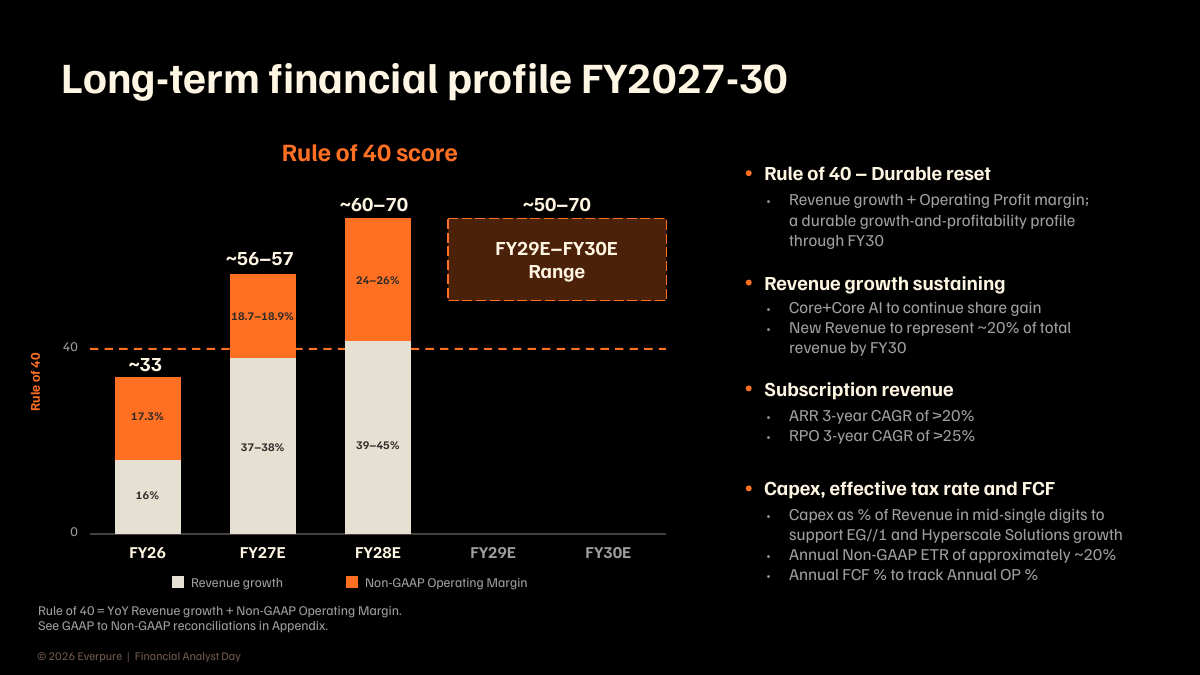
Asked by Morgan Stanley whether the lower floor of 50 for fiscal 2029 and 2030 reflected leeway on growth or on margins, Giancarlo answered, "we're not predicting a slowdown," and Robbiati said the figure was "rule of 40 at the 50% mark. Slice it the way you want to, my friend.". On the tax rate, Robbiati said Everpure carries a valuation allowance of about $838 million, that the deferred tax asset will have to be released as profitability becomes more durable, probably within the next few quarters, and that until then he cannot be precise on the non-GAAP rate beyond roughly 20%.
Capital allocation runs in three priorities: investing in the core business and strengthening the balance sheet, disciplined tuck-in M&A for technology, talent or go-to-market reach, and returning excess capital through buybacks and withhold-to-cover purchases that offset stock-based compensation dilution, with select additional buybacks possible.
A new disclosure: "Core + Core AI" against "New Revenue"
Robbiati said Everpure will track its progress in two aggregated categories, which he described as news. Core and Core AI covers FlashArray, FlashBlade and Evergreen//One, whether CPU- or GPU-attached; New Revenue covers Scale AI (FlashBlade//EXA solutions for neoclouds), Modern Data Software (Portworx, Pure Protect, Everpure Cloud, Data Intelligence from the 1touch acquisition, and Data Stream) and Hyperscale Solutions (DirectFlash technology for hyperscalers). Reported segmentation does not change; Everpure will give annual updates on new revenue growth at each year-end, starting with a fiscal 2027 baseline and a fiscal 2028 landing point, and warned that some of this revenue is lumpy and should not be measured quarterly.
He declined to break out new revenue's share of the fiscal 2028 outlook when TD Cowen read the chart as 10% to 20%, saying he had deliberately blurred the bar, and declined to quantify fiscal 2026 new revenue beyond noting that Everpure had previously cited tens of millions of dollars from hyperscale. The vast majority of new revenue today is software term licenses; hyperscale revenue is license plus some non-NAND componentry, all of it booked as product revenue, and the 75% to 85% gross margin previously given for hyperscale is what to assume for new revenue in total. Giancarlo added that new products carry lower gross and operating margins to begin with and that "with market share comes margin at every level," so they should accrete to the company average and preferably beyond. Operating expense lines should fall as a percentage of revenue even as absolute dollars rise for R&D and for sales and marketing, Robbiati said in reply to J.P. Morgan.
Addressable market sized at $207 billion by 2030
Robbiati said the storage market had historically been described as $50 billion growing about 9% a year, and that Everpure now sizes its total addressable market at $108 billion in 2026, rising to $207 billion in 2030. Core and Core AI is $51 billion growing at a 12%-plus CAGR to $79 billion, where Everpure competes with Dell, NetApp, HPE and IBM; Hyperscale Solutions is $44 billion growing at 22%-plus to $97 billion, against internal cloud solutions and SSD and hard-disk vendors; Modern Data Software is $9 billion growing at 26%-plus to $22 billion, against NetApp, Dell, Veeam, Cohesity, IBM and Databricks; and Scale AI is $5 billion nearly doubling to $9 billion, against VAST, DDN and WEKA. The estimates reflect the current solution set, with room to grow as it expands. The serviceable addressable market, restricted to all-flash, doubles from $34 billion in 2026 to $69 billion in 2030, driven by moderating commodity pricing at some point in the next four years and AI-created workloads, and Everpure's stated ambition is to be the number one provider of all-flash solutions. He cited 173 zettabytes of data generated in 2025, a 90-fold increase from 2 zettabytes in 2010, and estimates of $2 trillion to $3 trillion of hyperscaler AI infrastructure capex over the next three years.
Component costs up 153% since Q3 FY26, and share gains through every NAND cycle
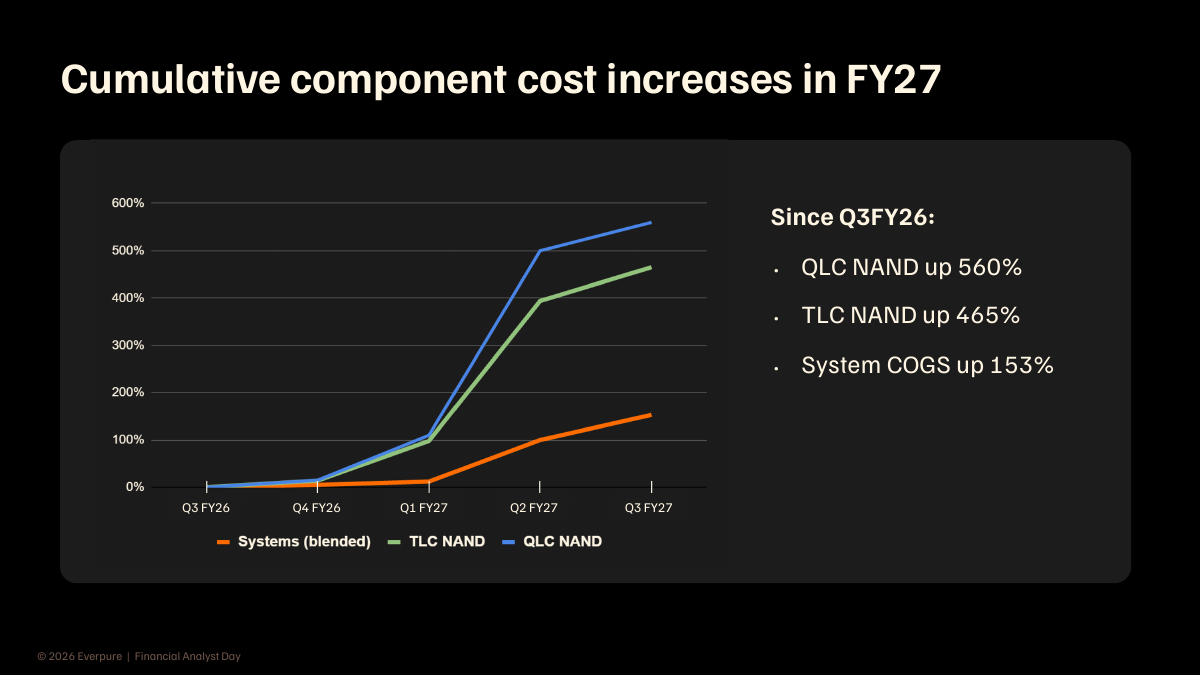
Robbiati showed cumulative component cost increases since the third quarter of fiscal 2026: QLC NAND up 560%, TLC NAND up 465% and blended system COGS up 153% through the third quarter of fiscal 2027, which he called unprecedented. Price adjustments to offset those costs have aided reported revenue growth, but "we are not, and never have been, a price-driven growth story," he said; momentum is fueled by underlying demand, share gains and expanding customer footprints.
Everpure's share chart overlaid with NAND regimes shows 10.7 points of cumulative share gain in deflationary periods, 1.1 points a year, and 3.5 points in inflationary periods, 1.4 points a year, since 2013. In inflationary periods customers prioritize quality and upgradable products to protect ROI, and in deflationary periods the architecture leverages falling component costs while customers optimize for labor, power and space, Robbiati said: "Ultimately, we do not view NAND pricing as a determinant of our growth.". Non-GAAP product gross margin runs at 66% against 55% for the next nearest competitor, a premium averaging 15.1 points in deflationary and 14.3 points in inflationary regimes since the first quarter of fiscal 2017. "We control our gross margins," Robbiati said, through disciplined, deliberate pricing. Evergreen//One has gained traction as Everpure contains prices, and because Everpure controls the configurations behind the SLA contracts it can manage that offering's margin; Evergreen//One TCV is on track to surpass a $1 billion annual run rate in fiscal 2027, from $520 million in fiscal 2026.
Giancarlo, asked by Guggenheim where the framework left room, described 15 years of experience that price dominates volume in both directions: when prices rise, demand does not rise as much but total dollars are higher, and when prices fall, volumes rise but do not make up the dollar decline. If prices stay where they are, Everpure expects to gain share in both volume and dollars; if they deflate, it expects to manage, depending on whether they deflate or crash, and current predictions assume current pricing. On supply, concern has gone way down on the core side, though memory remains constrained and Everpure's volume is small relative to that constraint, while new revenue is primarily software, so a hyperscaler's own sourcing would be the exposure. Lee said neoclouds procure the hardware for FlashBlade//EXA through their own supply chains and that no supply constraints are contemplated in the numbers.