Investor Day Recap · MRVL
Marvell targets $70 billion to $90 billion revenue by fiscal 2031, raises fiscal 2028 outlook to $20 billion and custom target to $12 billion-plus
Marvell set a fiscal 2031 revenue target of $70 billion to $90 billion, a 55% to 60% compound annual growth rate from $8.2 billion in fiscal 2026, and said the model implies non-GAAP EPS above $30. It raised its fiscal 2028 revenue outlook to about $20 billion from $18 billion, bringing its $18 billion data center target forward a year, and raised its fiscal 2029 custom revenue target to more than $12 billion from more than $10 billion on the XPU attach opportunity.
In this recap17 sections
- Overview of Marvell Technology
- The fiscal 2031 target: $70 billion to $90 billion in revenue
- Fiscal 2028 raised to $20 billion, data center target pulled in a year
- A $400 billion addressable market on moderating CapEx
- The financial model: 44% to 46% operating margin and ">$30" EPS
- Custom: XPU attach behind the raise to $12 billion-plus
- Members from here
- Connectivity: scale-out and scale-across today, scale-up optics next
- Switching and scale-up optics: the new legs
- Scaling the company: engineering, talent and supply
For reference
- Key updates and announcements
- Financial targets
- New products, customer wins and partnerships
- Why management believes it can deliver
- Cash flow and capital allocation
- What wasn't said
- Q&A
- Sources
Overview of Marvell Technology
Marvell Technology designs semiconductor solutions for data infrastructure; in its own description it moves, stores, processes and secures data, selling into two end markets, data center and communications/other. In its results for the second quarter of fiscal 2027, the quarter to August 1, 2026, the company reported net revenue of $2.739 billion, up 37% year over year, of which data center revenue was $2.2B, up 46%, and communications and other was $567.8 million, up 10%. Data center was 79% of revenue in the quarter. GAAP net income was $308.0 million, or $0.33 per diluted share, and non-GAAP net income was $865.9 million, or $0.94 per diluted share, with cash flow from operations of $605.5 million. Chairman and CEO Matt Murphy said in the release that AI-related bookings remained exceptionally robust and that the company was again raising its revenue outlook for fiscal 2027 and fiscal 2028. For the third quarter of fiscal 2027 the company guided to net revenue of $3.150 billion plus or minus 5%. At the event, the data center business was discussed in three parts: interconnect, switch and storage, and custom.
The fiscal 2031 target: $70 billion to $90 billion in revenue
Matt Murphy, Marvell's chairman and CEO, set a revenue target of $70 billion to $90 billion for fiscal 2031, against $8.2 billion in fiscal 2026, which he described as 10x growth at the $80 billion midpoint and a 55% to 60% compound annual growth rate over five years. Beneath that, Marvell expects data center revenue of about $67.5 billion to $87.5 billion in fiscal 2031, a 55% to 70% compound rate from fiscal 2026, plus about $2.5 billion from communications and other. Murphy said the figure was a bottom-up plan rolled up by customer, product and design win, not a top-down view, and that it assumed data center CapEx moderates over the period. "I understand the absolute numbers are large, but the growth rates are at or below what we're already delivering today," he said.
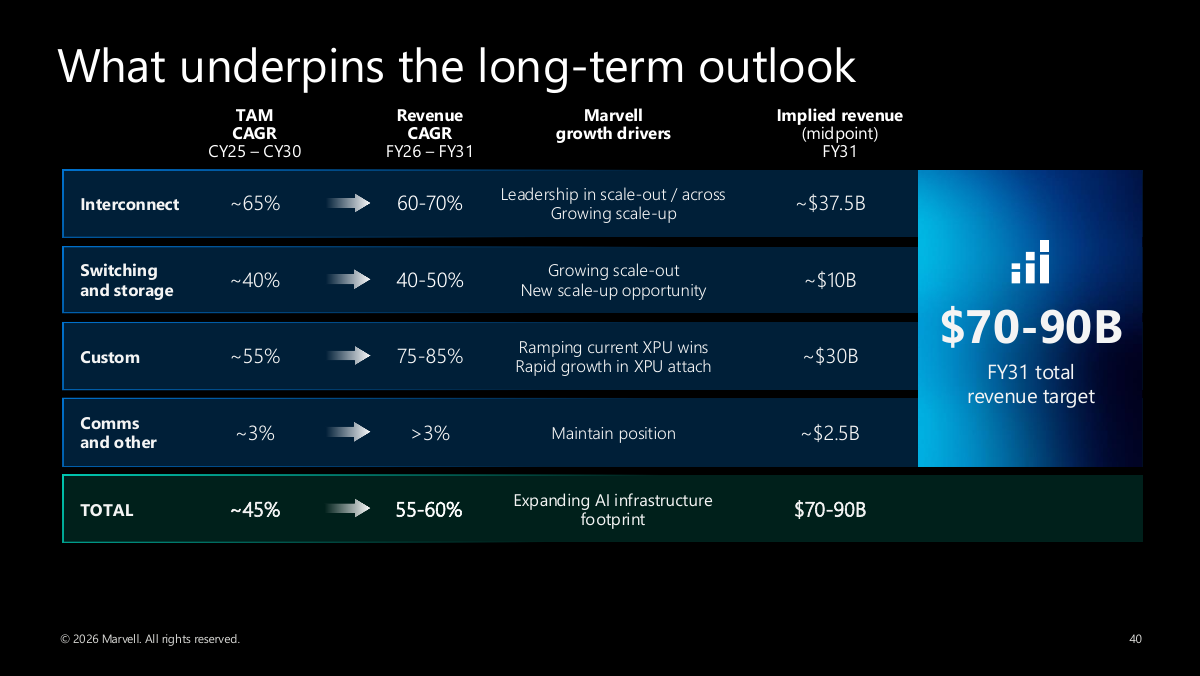
The midpoints by business are interconnect about $37.5 billion, switching and storage about $10 billion, custom about $30 billion and communications and other about $2.5 billion. For interconnect, Marvell assumes that scale-out growth, which has roughly doubled each year, moderates over time, that it maintains its positions in scale-out and scale-across, and that it executes on scale-up optics, where it has virtually no revenue today and expects growth to begin next year. In switching and storage, storage is already a business of more than $1 billion assumed to grow at a double-digit rate, scale-out switching is expected to be well north of $1 billion next year and to become a multi-billion-dollar business, with scale-up switching layered on top. In custom, Marvell assumes its existing XPU programs ramp into the fiscal 2029 plan and that growth from fiscal 2029 to fiscal 2031 is roughly in line with the market.
The same day brought three nearer-term changes: the fiscal 2028 revenue outlook moved to about $20 billion from the $18 billion given in August, the fiscal 2029 custom revenue target moved to more than $12 billion from more than $10 billion, and CFO Dan Durn said the long-term model implies non-GAAP earnings per share above $30 in fiscal 2031.
Fiscal 2028 raised to $20 billion, data center target pulled in a year
Murphy said Marvell expects about $12 billion of revenue this fiscal year, 47% growth, and that the fiscal 2028 outlook of about $18 billion given on the August earnings call, which represented 50% growth, now moves to about $20 billion, roughly 67% growth, with data center revenue growing about 80%. He said the August raise was driven by interconnect, scale-up optics and switching, and that the additional $2 billion for next year comes from the same trends: scale-out optics accelerating, scale-up optics growing and a switching portfolio that is "firing on all cylinders."
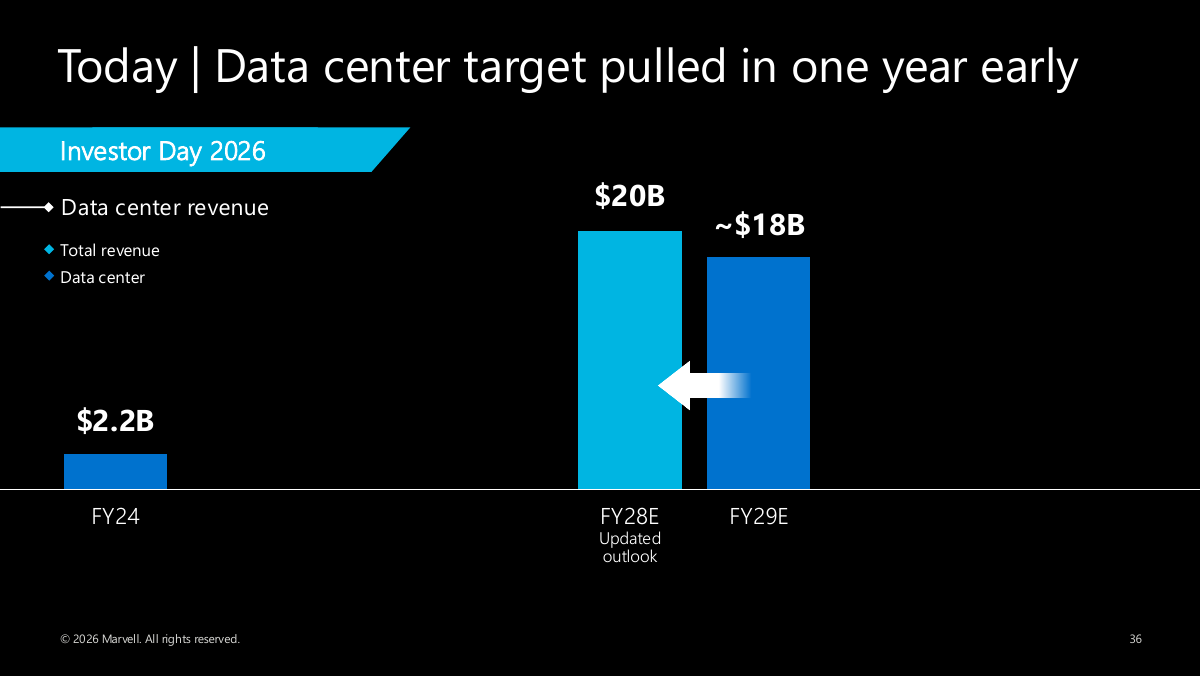
About $18 billion of the fiscal 2028 total is expected to come from data center, which Murphy said means Marvell now expects to reach the roughly $18 billion fiscal 2029 data center target almost a full year early. That target had itself been raised in June 2025 from the $15 billion for fiscal 2029 set at the April 2024 event, when data center revenue had just been $2.2 billion in fiscal 2024. Reaching $18 billion in fiscal 2028 would be roughly a 70% compound annual growth rate for data center from fiscal 2024, and Murphy said the plan from fiscal 2026, when data center revenue was $6.1 billion, to fiscal 2028 is about the same rate.
A $400 billion addressable market on moderating CapEx
Murphy said Marvell expects total data center CapEx to reach roughly $3 trillion by calendar 2030, a 35% compound rate from calendar 2025, and that the model assumes the current rate of CapEx growth moderates toward historical levels in the outer years. Within that, accelerated compute is roughly a $1.6 trillion opportunity, of which about $385 billion is data center TAM addressable by Marvell; with about $15 billion in communications and other, the total TAM is approximately $400 billion, growing at 45% a year from 2025 to 2030. The last time Marvell laid out its TAM it was less than $100 billion, so this is about a 4x increase. By business, Marvell sees the interconnect TAM growing about 65% a year to roughly $65 billion, switching and storage about 40% to $85 billion, custom about 55% to $235 billion, and communications and other about 3% to $15 billion.
Chris Koopmans, president and COO, said data center CapEx ended 2025 above $700 billion and is above $1 trillion this year, against the $1 trillion by calendar 2028 that analysts had forecast at the 2025 custom AI event; the model still expects CapEx growth to moderate to about 20% after 2027. He said the top ten hyperscalers drove more than 60% of CapEx last year and are expected to reach more than 70% by calendar 2030, that the top four US hyperscalers alone were more than half of total CapEx last year, and that Marvell can hit the vast majority of its goals with those four. "We aren't counting on some major new customer win or a new home run design win," Koopmans said. Breaking the fiscal 2031 forecast down, he counted hundreds of products across the top ten hyperscalers and more than 35 sockets at the top four, each worth millions of dollars.
In the Q&A, Murphy said CapEx in the model is not linear: it is growing about 70% or more now and is expected to grow more like 20% at the tail end, which he described as a cushion, and that with line of sight to $20 billion next year the forecast effectively runs from 2027 to 2030.
The financial model: 44% to 46% operating margin and ">$30" EPS
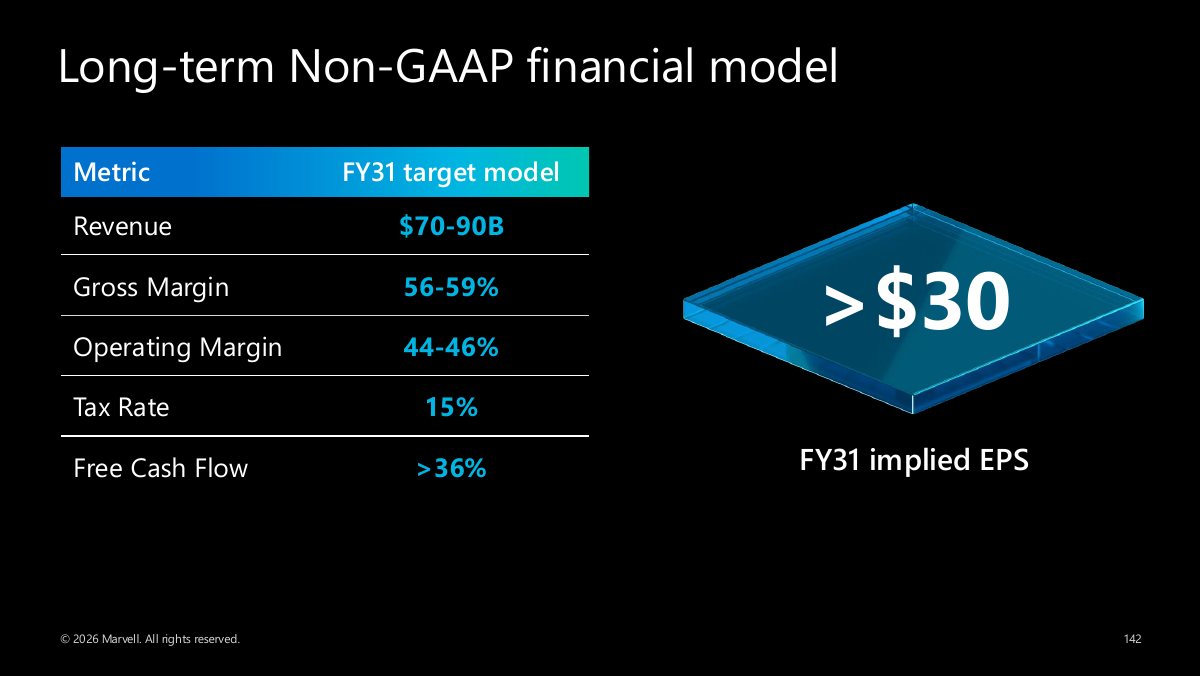
Dan Durn, CFO, laid out a fiscal 2031 non-GAAP target model of $70 billion to $90 billion in revenue, gross margin of 56% to 59%, operating margin of 44% to 46%, a 15% tax rate and a free cash flow margin above 36%. Together, he said, those imply non-GAAP EPS of more than $30 a share in fiscal 2031 at the midpoint, which he called "30 in 30" because fiscal 2031 is the equivalent of calendar 2030. The operating margin target is 6 points higher than the prior long-term target set a handful of years ago.
Durn said gross margin is mix dependent: custom silicon carries a relatively lower gross margin but an attractive operating margin because of customer-funded NRE and scale, while merchant silicon has a higher gross margin and a higher R&D profile. The low end of the gross margin range would likely require significant upside to the base-case custom revenue forecast, while outperformance in connectivity would push toward the upper end. "So the mix dependence acts as a bit of a hedge," he said. Marvell expects operating expenses to grow at roughly half the rate of revenue, delivering operating leverage and earnings growth faster than revenue through fiscal 2031.
He said data center revenue is the primary driver, with a roughly 65% CAGR at the midpoint, split into interconnect about 65%, switching and storage about 45% with switching faster, and custom about 80%, while communications and other grows at the same low-single-digit rate discussed in the past. Looking back, Durn said Marvell delivered a 23% revenue CAGR from fiscal 2021 to fiscal 2026 against the 15% to 20% target set in 2021, grew non-GAAP operating income at a 32% CAGR, invested $8 billion in organic R&D and $11 billion in M&A, and returned about $4 billion to shareholders through dividends and repurchases.
Custom: XPU attach behind the raise to $12 billion-plus
Murphy said the custom business, built essentially from scratch over five years, was about $1.5 billion last year and now ships custom silicon to all four US hyperscalers. Having told investors last year to expect custom revenue to more than double in fiscal 2028 on a path to more than $10 billion in fiscal 2029, Marvell now expects fiscal 2029 custom revenue to more than triple from fiscal 2028, to more than $12 billion. He said the update is primarily driven by the rapidly expanding XPU attach opportunity, including the strategic agreement announced in August, and that "this is not a single customer and it is not a single socket." By fiscal 2031, Marvell expects custom to be much more balanced between XPU and XPU attach sockets, with no single socket concentration.
Will Chu, who runs the custom cloud solutions business, said that since last year's event, when 18 won sockets were disclosed, Marvell has added multiple multi-generational wins across the top four hyperscalers and early wins with others, and that all XPU programs are on track and have shipped in high volume. XPU attach sockets are semi-custom, leverage Marvell's merchant IP, persist across XPU generations and extend Marvell's reach to systems with non-Marvell XPUs. Beyond NICs, memory expansion and storage, he introduced two categories not discussed before: AI infrastructure management silicon, a semi-custom processor built on Octeon technology for AI servers with more than 1,500 sensors that need about 1,000x the performance of a traditional BMC, with programs at multiple hyperscalers; and inference accelerators attached to the XPU, where Marvell is engaged with multiple customers. Chu said investors could imagine one to two sockets attaching to each XPU at ASPs of around $1,000, so that each attach category can be a billion-dollar opportunity and some several billions.
Koopmans said Marvell has publicly disclosed strategic agreements with three of the five largest companies in the world by market cap: a five-year agreement with AWS from 2024 covering custom AI products, switching, data center interconnect and optics, to which co-packaged optics was added after the Celestial AI acquisition; an agreement with NVIDIA earlier this year covering optics and photonics, scale-up networking with NVLink Fusion and AI RAN; and most recently one with Google outlining a $120 billion opportunity over 6.5 years for custom products attached to the TPU ecosystem, separate from existing connectivity business. Asked in the Q&A, Murphy said the August agreement is modeled in fiscal 2031 in a way that is "very pragmatic and judged," adding: "So don't think of this as the max case when you've built your model on what the value of that warrant is." He also said the roughly 13% share of the $235 billion custom TAM that $30 billion implies reflects a selective approach to XPU programs alongside what he expects to be a very strong share in XPU attach, a market Marvell sized at about $15 billion a year ago that has since grown by multiples.