Investor Day Recap · MDB
MongoDB raises Atlas growth target to mid-20s percent, adds $1 billion buyback as Ittycheria returns as interim CEO
MongoDB used its 2026 Investor Day to replace last year's three-to-five-year model with a three-year one: total revenue growth of 20%-plus, Atlas revenue growth in the mid-20s percent, EA & Other ARR growth of 10%-plus and GAAP profitability from fiscal 2027. The board approved another $1 billion of buybacks. Three products were launched, and Dev Ittycheria, back as interim CEO after CJ Desai's resignation, said the company needs no fixing.
In this recap18 sections
- Overview of MongoDB
- A three-year model with Atlas at mid-20s percent
- Ittycheria returns as interim CEO after Desai's exit
- Three launches: MongoDB 9.0, Atlas Infinite and Atlas Agent Engine
- AI: 3% to 5% of Atlas revenue, growing 165%
- Growth evidence: Atlas dollars, an EA inflection and larger customers
- Members from here
- Margin, investment and cash
- Go-to-market: a $5 billion-plus path through executive buyers and migrations
- Partners as the scale engine
- Customers on stage: Citizens Bank and Emergent Labs
For reference
- Key updates and announcements
- Financial targets
- New products, customer wins and partnerships
- Why management believes it can deliver
- Cash flow and capital allocation
- What wasn't said
- Q&A
- Sources
Overview of MongoDB
MongoDB sells a document-model database and data platform that runs as the Atlas cloud service or as self-managed software under the Enterprise Advanced (EA) licence, with search, vector search, embedding and reranking capabilities built in. In its results for the quarter to July 2026, released on September 1, the company reported total revenue of $771.8 million, up 30% year over year, with subscription revenue of $747.1 million and services revenue of $24.6 million. The release broke subscription revenue into Atlas-related revenue of $565.9 million and MongoDB Enterprise Advanced and other revenue of $181.2 million, and said Atlas revenue grew approximately 29% and EA & other revenue approximately 36%. CFO Mike Berry said in that release that non-GAAP operating margin was 24% and free cash flow was $137.6 million, and the company raised its full-year fiscal 2027 revenue guidance to $2.99 billion to $3.03 billion. The release counted more than 70,600 customers, including approximately 75% of the Fortune 100, and $2.4 billion in cash, cash equivalents, short-term investments and restricted cash.
A three-year model with Atlas at mid-20s percent
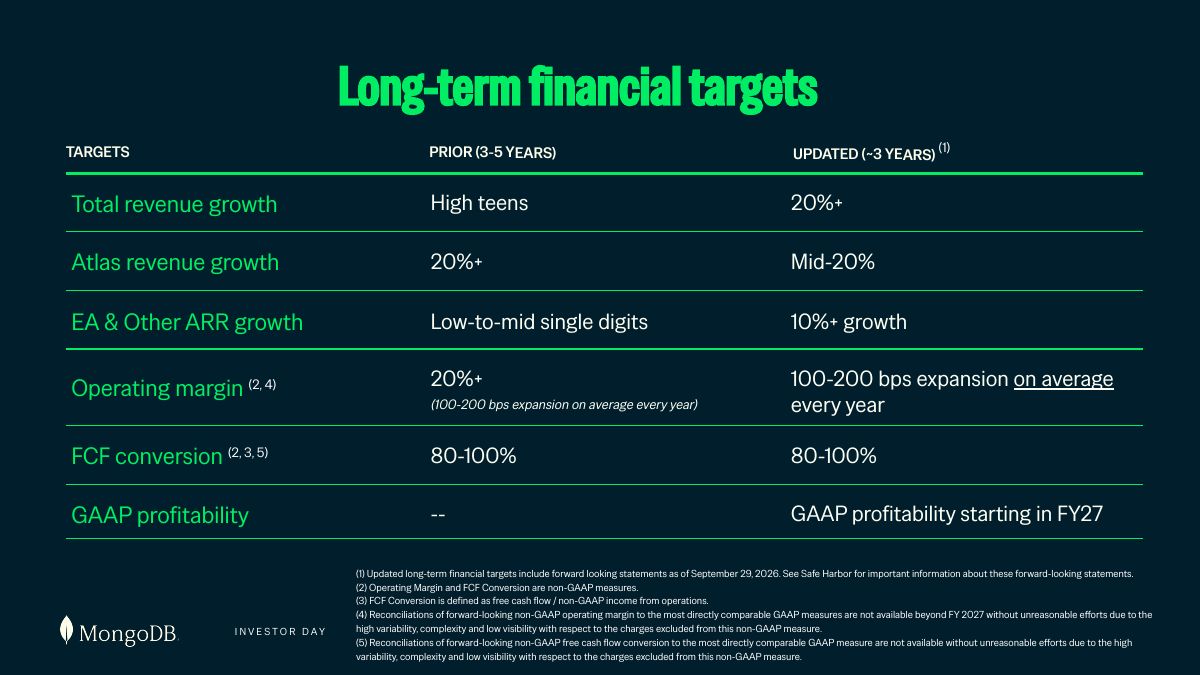
Mike Berry, chief financial officer, said the long-term model introduced a year ago had been shortened from three-to-five years to about three, telling investors, "Folks, 5 years is a long, long time." The updated target for total revenue growth is 20%-plus, against the prior high teens, and MongoDB said it is "very comfortable" expecting growth north of 20% because it has two growth drivers, Atlas and EA. The Atlas revenue growth target moved from 20%-plus to the mid-20s percent, which Berry called "a meaningful jump", while stressing that the guidance framework used for the last three quarters has not changed and that MongoDB will stay prudent in projecting a consumption product. The company listed enterprise AI workloads, AI-native contribution, new products, application modernization and partnerships as targeted sources of upside to the Atlas figure, with enterprise AI adoption "probably number one".
For EA & Other, MongoDB is committing to ARR growth of 10%-plus over the three years, up from an implied low-to-mid single digits, and bases the target on ARR because that mitigates the swings in multi-year revenue recognition. Berry said this is not a ceiling and that MongoDB expects double-digit growth "if all the new products pick up". The operating margin target stays at 100-200 basis points of expansion on average every year. Free cash flow conversion stays at 80-100%, and MongoDB now expects GAAP profitability in fiscal 2027 and beyond. Berry said the fiscal 2027 guide equates to a "Rule of 44" and that doing what the company says "and maybe a little bit better" would bring it close to a Rule of 50 exiting the three years, though he would not commit to that.
Separately, Berry announced that the board had approved another $1 billion under the share repurchase plan.
Ittycheria returns as interim CEO after Desai's exit
Berry opened the day by addressing the news that CJ Desai resigned on September 28th 2026 and that Dev Ittycheria had been named interim president and CEO, adding that Desai was moving to a role at Meta and that the company could say nothing beyond its 8-K. The board has already launched a search for a new CEO, and Berry said it was "business as usual", with the whole management team present and aligned with the plans presented.
Ittycheria, who had remained on the board over the past year, said his focus was to drive momentum, execute on product and go-to-market, and provide a seamless transition. "The company's on strong footing," he said. Asked by an analyst from Bank of Montreal what Desai had done well and what the next leader should look like, Ittycheria said Desai had elevated the company's ability to sell at the C-level and helped push deals over the line in key accounts, but that groundwork by the go-to-market team drove those deals. On the successor, he said the decision would involve the board and the executive team, that no single domain expertise is sought, and that the person should understand both building software and go-to-market, since MongoDB runs an enterprise sales force, a commercial organization, a self-serve business and a partner channel. An analyst from Morgan Stanley asked about the volume of organizational change; Ittycheria said the company had handled executive turnover before, noting he himself served as temporary CRO for almost a year after the IPO. To an analyst from RBC, he said the decision to invest in EA was made while he was still CEO, after large financial institutions said they wanted to keep running workloads on-premises.
Berry later added that MongoDB had been without a CRO for six months and now has one in Ryan Mac Ban. "We feel much better about where go-to-market is sitting here today than we did last year because of the coming transition," he said.
Three launches: MongoDB 9.0, Atlas Infinite and Atlas Agent Engine
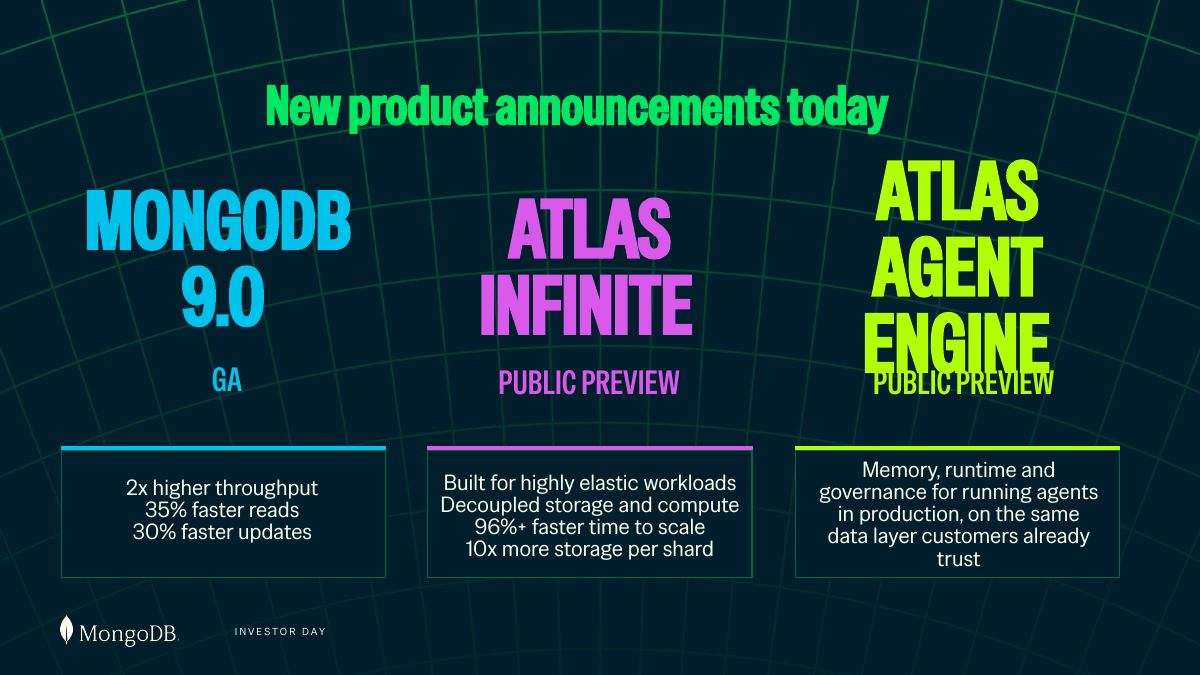
Ben Cefalo, chief product officer for core products, said MongoDB 9.0 is generally available with up to 20% higher transactional throughput, 35% faster reads, 30% faster updates and two times the throughput on large instances, compared with version 8.0. About 80% of the Atlas fleet is already on 8.0, which Cefalo said was adopted twice as fast as earlier releases and was followed by higher retention. He argued that better price performance has historically meant more consumption, citing Jevons' paradox: "When we introduce better price performance, we've seen stronger growth in subsequent periods." Version 9.0 also makes prefix, suffix and substring queries on encrypted data generally available under Queryable Encryption, which the deck calls an industry first and only.
Atlas Infinite, in public preview on AWS only, decouples storage from compute so each can scale independently, which Cefalo called Atlas's biggest architectural change since its launch in 2016. The deck shows roughly 100% faster addition of read capacity, about 200% more performance per dollar on I/O-heavy workloads and 10 times more storage per shard, at 128 terabytes. It is a new deployment option requiring no application code changes, the existing Atlas database is being renamed Atlas Core Database, and MongoDB has been working on Infinite for more than two years. Among preview customers, ICON Solutions processed more transactions per second and a fraud-prevention platform ran four times its normal peak traffic. "And infinite means we will win when the demand is unpredictable," Cefalo said, describing agentic workloads as bursty and intense compared with the predictable cadence of user-driven ones.
Pablo Stern-Plaza, chief product officer for AI and emerging products, introduced Atlas Agent Engine, now in public preview: "This is one of the largest expansions of our platform in company history." It addresses three gaps he said customers raised: an enterprise-grade memory system that handles long- and short-term memory automatically, security isolation with governance and guardrails built in, and openness to any cloud, model, framework, observability tool or data source. All existing Atlas customers are entitled to it with no new contract, and MongoDB sees monetization both from the new runtime and memory components and from the Atlas consumption they pull through. Design partners include Paysafe and CDK, and the deck shows SI launch partners already using and selling it. In Q&A, Stern-Plaza said the memory component breaks long-term memory into procedural, episodic, taxonomic and semantic types and is offered as an SDK and through MCP.
Berry set out when the money arrives. The EA search and vector search features, launched June 30, 2026, are monetized through incremental licences, with early revenue this fiscal year and more in fiscal 2028. Atlas Infinite is expected to reach general availability in early fiscal 2028 and build through that year, with no meaningful revenue expected until fiscal 2029; Agent Engine should go GA later this fiscal year or early next, with momentum in fiscal 2028. "We hope we go faster, but that's the base case today," Berry said.
AI: 3% to 5% of Atlas revenue, growing 165%
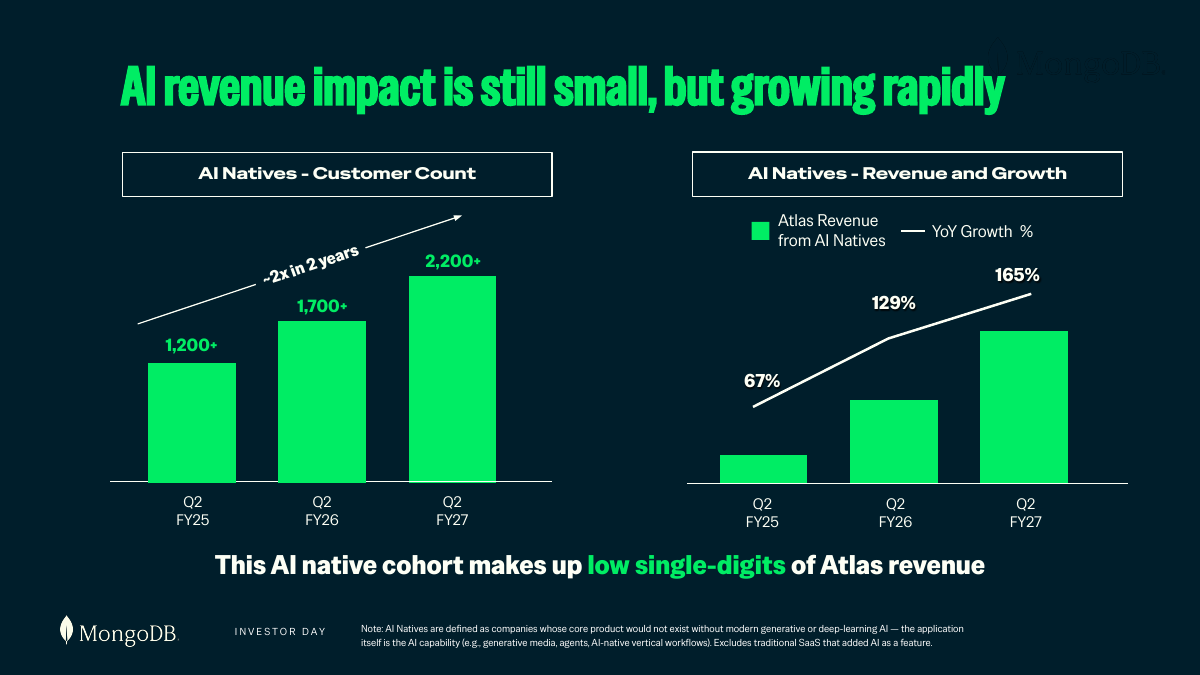
Berry gave a point-in-time definition of AI natives and frontier labs, covering model builders, AI infrastructure companies and software companies whose product would not exist without generative or deep-learning AI, and warned the definition will change. On that basis, AI natives are less than 5% of Atlas revenue — "think of 3% to 5%" — with their customer count at 2,200-plus, roughly double two years ago, and their Atlas revenue growing 165% year over year, after 129% and 67% in the two prior years. "It's still small, but it's growing very, very quickly," Berry said. Asked by an analyst from Scotiabank what it would take to reach double digits, he said more workloads at the larger labs and the AI-native cohort scaling, adding that the lack of dependency on any single customer was "a relatively good thing".
Among wider signals, about 40% of Atlas ARR now comes from customers with at least one AI use case, up from about 30% a year ago; 48% of Atlas customers above $100,000 of ARR use two or more platform features, up from 34% two years ago; and vector search customers have grown four times in two years. Stern-Plaza said the Voyage AI customer base has doubled quarter over quarter for the last two periods, and the managed MCP server launched in August has seen eight times the usage of its first week. Berry named the top three enterprise AI use cases as giving systems real-time context from company data, running autonomous agents, and AI-powered customer support.
Growth evidence: Atlas dollars, an EA inflection and larger customers
Berry said Atlas has now added more year-over-year revenue dollars for six straight quarters, reaching $127 million in the second quarter of fiscal 2027 after flatlining around $76 million in fiscal 2025, and that this growth has come across self-serve and sales-sold channels, led by large enterprises in the US and EMEA. Marketplace transactions through the three hyperscalers now represent about half of total revenue. EA & Other ARR growth averaged mid-single digits until an inflection in the third quarter of fiscal 2026 and has been double digit for three consecutive quarters, at 11% in the latest, before the search features were added. About two-thirds of EA customers with more than $100,000 of ARR also use Atlas, and that cohort is growing faster than the total.
New disclosures included subscription ARR of $2,886 million at the end of the second quarter, split between $2,281 million for Atlas and $605 million for EA & Other, growing 25% against 23% and 22% in the two prior years; Berry said this will be shown annually, not quarterly. Customers above $5 million of ARR number 90 and have grown at a 57% compound rate since fiscal 2021, against 34% for those above $1 million and 23% for the 70,600 total. "This is a customer play, not a workload-by-workload play," Berry said. Net dollar retention is 122% across both products.
On last year's commitments, MongoDB reported fiscal 2026 Atlas growth of 28.7% against a 20%-plus target, EA & Other growth of 7.3%, revenue growth of 22.8%, operating margin of 18.5% and free cash flow conversion of 108%; the high end of fiscal 2027 guidance implies Atlas growth of about 27%, EA & Other of about 11%, revenue growth of 21-23% and operating margin of about 21%. Berry said this would be the second straight year of total revenue acceleration at the high end and the first time in three years that double-digit EA growth has been projected. IDC sizes the database market at $193 billion by 2030, growing at a 12% compound rate, and MongoDB's share is about 2.2% on its guidance.