Investor Day Recap · HPE
HPE raises fiscal 2027 networking growth guide to high teens to low 20s percent, synergy target to $800 million; announces $1.2 billion Vultr order
HPE raised its fiscal 2027 networking revenue growth guide to high teens to low 20s percent from 14% to 17%, increased its fiscal 2028 Juniper cost-synergy target to $800 million from at least $600 million, and set a fiscal 2026–2029 framework of a high teens revenue CAGR and mid-to-high 20s percent operating margins. It also announced a $1.2 billion AMD Helios order from Vultr and now expects cumulative networks-for-AI orders to exceed $3 billion.
In this recap16 sections
- Overview of Hewlett Packard Enterprise
- Fiscal 2027 guide: growth roughly doubles, margin to mid-to-high 20s percent
- Cost synergy target increased to $800 million, with partner and systems integration still ahead
- Helios, Vultr and Oracle: the data center and routing opportunity
- Supply: orders outrunning revenue, purchase commitments doubled
- Members from here
- Long-term framework: share gains in every category
- Campus & Branch, security and the self-driving network
- ServiceNow: a customer's account of the self-driving network
For reference
- Key updates and announcements
- Financial targets
- New products, customer wins and partnerships
- Why management believes it can deliver
- Cash flow and capital allocation
- What wasn't said
- Q&A
- Sources
Overview of Hewlett Packard Enterprise
HPE describes itself, in its results release for the third quarter of fiscal 2026 (filed September 2, 2026), as a provider of enterprise technology that brings together AI, cloud and networking. In that release, for the quarter ended July 31, 2026, the company reported revenue of $12.2 billion, up 34% from the prior-year period, which the release described as a record, a GAAP operating profit margin of 11.4% (non-GAAP 16.2%), GAAP diluted EPS of $1.06 and free cash flow of $1.0 billion. The release reports two main segments: Cloud & AI, with quarterly revenue of $9.0 billion, up 25.4%, and Networking, the subject of the event, with revenue of $2.9 billion, up 74.9% from the prior-year period, at a 22.0% operating profit margin. Within Networking, the release reported Campus & Branch revenue of $1.4 billion (up 31.0%), Routing of $788 million (up 270.0%), Data Center Networking of $382 million (up 112.2%) and Security of $281 million (up 75.6%). In the release, the company raised its fiscal 2026 revenue growth expectation for the Networking segment to 73% to 74% and its fiscal 2027 free cash flow guidance to at least $5.0 billion; CEO Antonio Neri said AI is becoming a multi-year growth driver, and CFO Marie Myers said the company plans to return at least 75% of free cash flow to shareholders in the fourth quarter. HPE closed its acquisition of Juniper Networks in July 2025, and the networking figures shown at the event were normalized to include Juniper from the start of fiscal 2024.
Fiscal 2027 guide: growth roughly doubles, margin to mid-to-high 20s percent
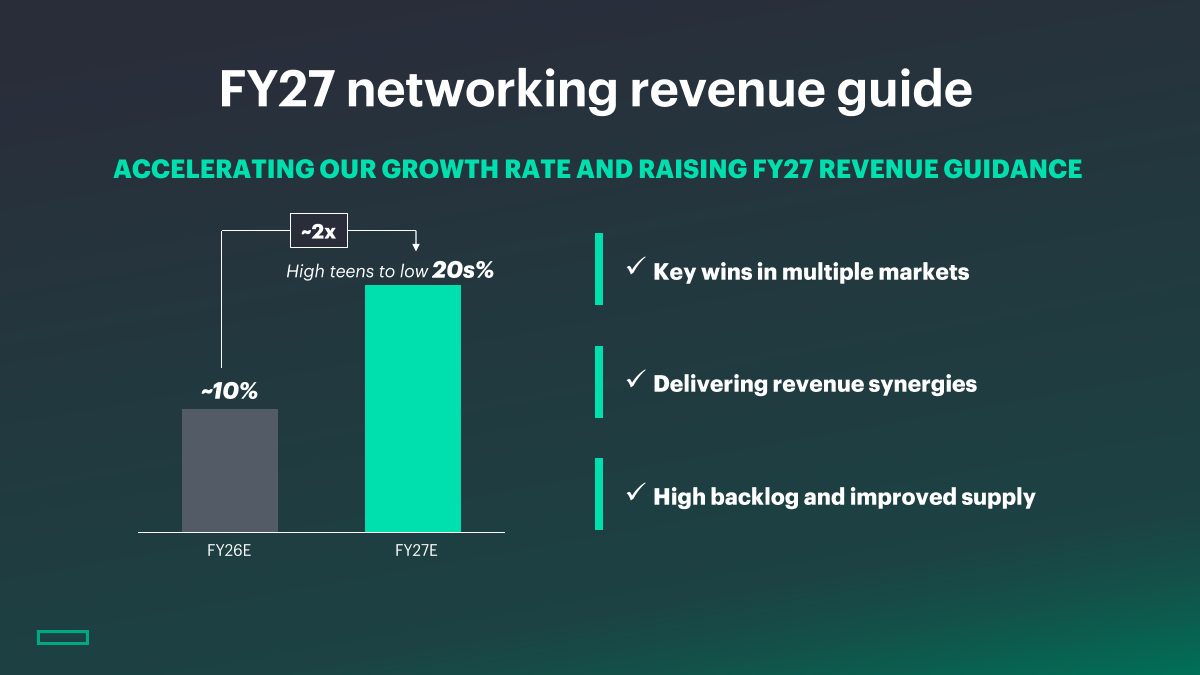
Rami Rahim, who leads HPE's networking business, said HPE now expects fiscal 2027 HPE Networking revenue growth of high teens to low 20s percent, up from the 14% to 17% guidance given at the third-quarter earnings call. He attributed the increase to "strong portfolio demand, the incremental Helios opportunity, and improved order conversion". The presentation shows the new range as roughly twice the approximately 10% growth expected for fiscal 2026, and cites key wins in multiple markets, revenue synergies, high backlog and improved supply. HPE expects a more back-end-loaded year than normal, given the timing of Helios shipments and the anticipated contribution from the Oracle agreement.
HPE expects its fiscal 2027 networking operating margin to expand to mid-to-high 20s percent, from a fiscal 2026 expectation of low 20s percent, an outlook Rahim said had been given on the third-quarter earnings call. The presentation lists integration and transformation, scale benefits from revenue growth and disciplined investments as the drivers. Looking beyond fiscal 2027, HPE is projecting a high teens networking revenue CAGR from fiscal 2026 through fiscal 2029, with operating margins in the mid-to-high 20s percent range from fiscal 2027 to fiscal 2029, and expects to gain market share in data center, routing and Campus & Branch.
Asked by Morgan Stanley's analyst what had changed in the 28 days since earnings, Rahim said the one new factor was Helios, which is now reflected in the opportunity for next year and beyond. Asked by Bank of America's analyst why the higher growth outlook had not lifted the margin range, Shannon Cross, HPE's chief strategy officer, said the company is "investing heavily in the business to be able to drive that growth" and expects "a linear progression over the next several years in terms of operating margins". Rahim added that the synergies were achieved "without in any way impairing our ability to compete and grow," and at a lower cost than originally anticipated.
Cost synergy target increased to $800 million, with partner and systems integration still ahead
Rahim said that when the Juniper transaction closed in July 2025, HPE raised its original cost synergy target from $450 million to at least $600 million in annual run-rate savings by fiscal 2028, and that given its progress it is now increasing the fiscal 2028 target to $800 million. The savings come from areas including SG&A, go-to-market harmonization and the elimination of duplicate R&D costs, and HPE is running ahead of its synergy plan while spending less on integration. Combining the sales organizations, which HPE called Sales Day One, was completed globally about six months after close, with one catalog, one compensation plan and one set of account rules for all sellers.
Two integration priorities remain. Partner Day One, planned for November 1, 2026, will converge the Juniper and Aruba programs into one program, HPE Partner Ready Vantage, so that all 60,000 HPE partners can sell the full networking portfolio; Rahim said only around 10% of HPE Aruba Networking and Juniper partners overlapped before the acquisition. The second is a single lead-to-cash system: the first phase, integrated quoting and ordering, launches in November 2026, supply chain processes are to be unified by the end of 2027, and improvements continue through 2028. Asked by Morgan Stanley's analyst what level of cross-sell overlap would count as success, Rahim said the channel opportunity starts with Campus & Branch and declined to give a number, saying it is "still very low right now, and it's only going to go up".
The presentation shows normalized networking revenue rising from $9.3 billion in fiscal 2024 to $11.3 billion at the fiscal 2026 midpoint, operating profit from $1.6 billion to $2.5 billion, and operating margin from about 18% to about 22%.
Helios, Vultr and Oracle: the data center and routing opportunity
HPE expects its data center networking revenue to grow at a low to high 50s percent CAGR from fiscal 2026 through fiscal 2029, against a market CAGR of 44%. Rahim said AMD Helios brings together Juniper's networking technology with HPE's compute, liquid cooling and rack-scale engineering in an Ethernet-based scale-up solution, opening a new addressable market in which the networking trays can be sold as part of an HPE rack or independently to other solution providers. HPE believes Helios represents more than a $1 billion networking opportunity over the next two years, and networking tray orders have already exceeded $200 million. Rahim said that on the morning of the event HPE announced a $1.2 billion AMD Helios order from Vultr, HPE's first order for the integrated system, which features its new purpose-built scale-up switch and software.
Cross said the Vultr deal is a full rack, of which networking is a portion, and that HPE will balance rack sales against being a merchant vendor of trays, in part because of the working capital a full rack requires when "everybody is fully committed to at least $5 billion of free cash flow next year". Rahim told Citi's analyst that the $1 billion-plus Helios outlook did not assume significant market share gains because it is still early, and that HPE is the one networking company among the Helios suppliers. Praveen Jain, who leads data center networking, said HPE delivered a Tomahawk 5-based switch ahead of every OEM and was the first vendor to deliver a fully liquid-cooled Tomahawk 6-based switch, and that the Helios tray would not have been possible without HPE and Juniper coming together.
In routing, HPE expects a low to high 20s percent CAGR from fiscal 2026 through fiscal 2029, from the AI on-ramp, served by the MX platform and Trio silicon, and from data center interconnect, served by the PTX portfolio and Express silicon. Rahim pointed to a recent win with Oracle, in which HPE is participating in Oracle's multiyear gigawatt-scale AI infrastructure build-out in both routing and switching platforms across data centers globally. He said HPE had worked with Oracle on routing for a long time and was "given a much larger opportunity" after years of co-innovation, coupled with HPE's services, support and financial services.
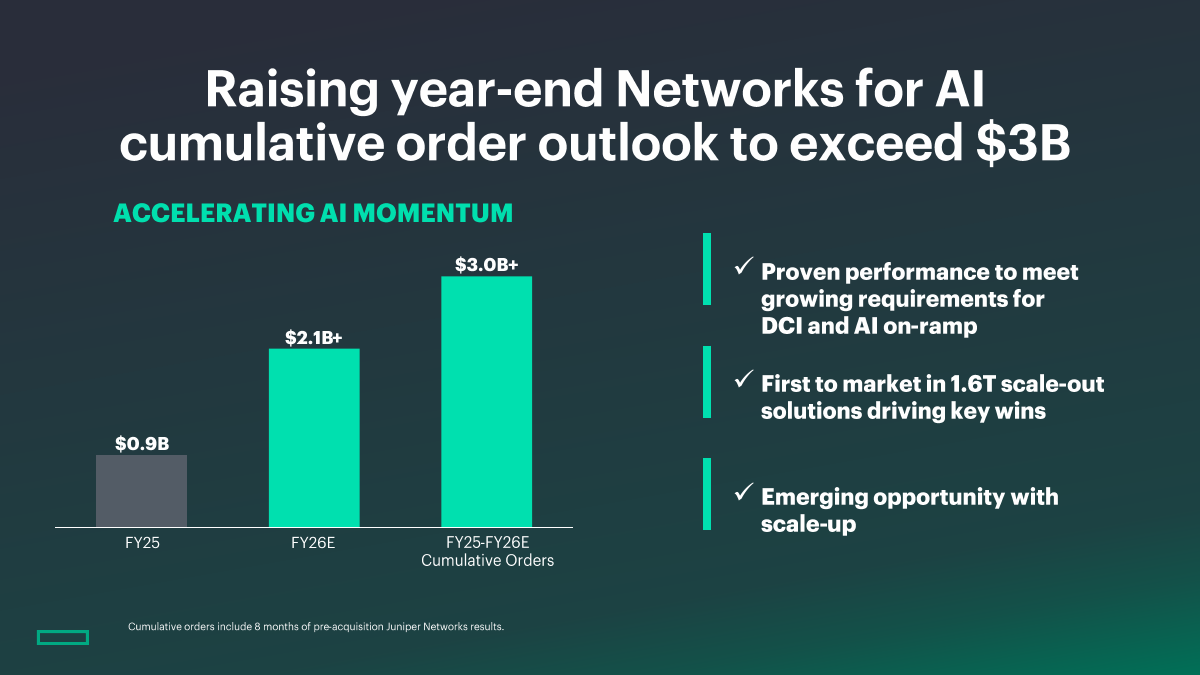
Based on continued demand, HPE now expects cumulative networks-for-AI orders to exceed $3 billion by the end of fiscal 2026, up from the $2.5 billion to $3 billion estimate given at the third-quarter earnings call. The presentation shows $0.9 billion of such orders in fiscal 2025 and more than $2.1 billion expected in fiscal 2026, with the cumulative figure including eight months of pre-acquisition Juniper results.
JPMorgan's analyst asked about gross margin as data center moves from 10% to 15% of networking revenue toward a third. Rahim said data center switching is on average lower gross margin, including scale-out and scale-up, but that after R&D and sales costs it is "operating margin neutral for us" and is reflected in the outlook. He said cloud providers would be where the bulk of data center growth comes from, with some concentration, and that he did not think Oracle would be a unique win. Asked by Raymond James' analyst about compute attach, Rahim said Helios should carry higher-than-normal attach rates as an integrated system, while outside Helios "attach rates are still low, but we want them to be higher," and raising them is a big part of the revenue synergies.
Supply: orders outrunning revenue, purchase commitments doubled
Rahim said third-quarter orders grew 3.5 times faster than revenue and that HPE doubled its networking supply purchase commitments in the last quarter, which it is confident will ease constraints into fiscal 2027. The presentation shows commitments at twice the third-quarter fiscal 2025 level in the second quarter of fiscal 2026 and four times that level in the third quarter. In reply to Daiwa Capital Markets' analyst, HPE said fiscal 2026 growth is supply-limited and fiscal 2027 will be less so but still supply-limited, that it had underestimated both the market's growth and its own execution, and that purchase commitments have more than quadrupled year over year, with CEO Antonio Neri personally involved in securing supply. Rahim told Wolfe Research's analyst that growth is "very much a unit-based growth driver," although HPE has raised prices to deal with rising component costs.