Investor Day Recap · ACN
Accenture sets three-year ambition: mid-single-digit growth in FY27–FY28, step-up to mid-to-high single digits in FY29, with 10–30 bps annual margin expansion
Accenture set out a three-year ambition at its investor day: mid-single-digit revenue growth in local currency in fiscal 2027 and 2028, mid-to-high single digits from fiscal 2029, 10–30 basis points of operating margin expansion each year and free cash flow of at least 1.1 times net income. Chair and CEO Julie Sweet said the addressable market has doubled to $3 trillion and that a network of businesses now 6% of revenue could reach 12% by FY29.
In this recap17 sections
- Overview of Accenture
- A three-year ambition, with the step-up pencilled in for FY29
- Margin: four levers, and revenue growing faster than headcount
- Capital allocation: $9.5 billion to shareholders and about $8 billion of acquisitions in FY27
- Doubling the addressable market to $3 trillion
- Members from here
- The network of businesses: nine today, a tenth planned, and an ambition to reach 12%
- AI efficiencies, pricing and the managed-services question
- Markets and clients: five Americas themes, three European forces, Sainsbury's to 2033
- Talent: headcount to keep growing, but more slowly
For reference
- Key updates and announcements
- Financial targets
- New products, customer wins and partnerships
- Why management believes it can deliver
- Cash flow and capital allocation
- What wasn't said
- Q&A
- Sources
Overview of Accenture
Accenture is a global professional services company that helps large enterprises and governments modernize their technology and adopt AI, delivering consulting and managed services across 13 industries and three geographic markets. In its results for the fiscal year to August 31, 2026, released on October 1, 2026, the company reported revenue of $74.2 billion, an increase of 6% in U.S. dollars and 5% in local currency, split between consulting revenue of $36.9 billion and managed services revenue of $37.3 billion. The same release reported fourth-quarter revenue of $18.7 billion, up 6% in U.S. dollars and 7% in local currency, and new bookings of $84.5 billion for the year. For fiscal 2026 the release reported a GAAP operating margin of 15.4% and an adjusted operating margin of 15.8%, GAAP diluted EPS of $13.56 and adjusted EPS of $13.97, free cash flow of $11.6 billion and $11.5 billion of cash returned to shareholders. By geographic market, the release gave fiscal 2026 revenue of $36.5 billion for the Americas, $27.0 billion for EMEA and $10.7 billion for Asia Pacific, and said the company had approximately 814,000 people and served approximately 9,000 clients. In the release, Chair and CEO Julie Sweet pointed to 141 quarterly client bookings of $100 million or more in the year. The release also gave a fiscal 2027 outlook of revenue growth of 3% to 6% in local currency, GAAP diluted EPS of $14.39 to $14.81, free cash flow of $11.0 billion to $11.8 billion and at least $9.5 billion returned to shareholders.
A three-year ambition, with the step-up pencilled in for FY29
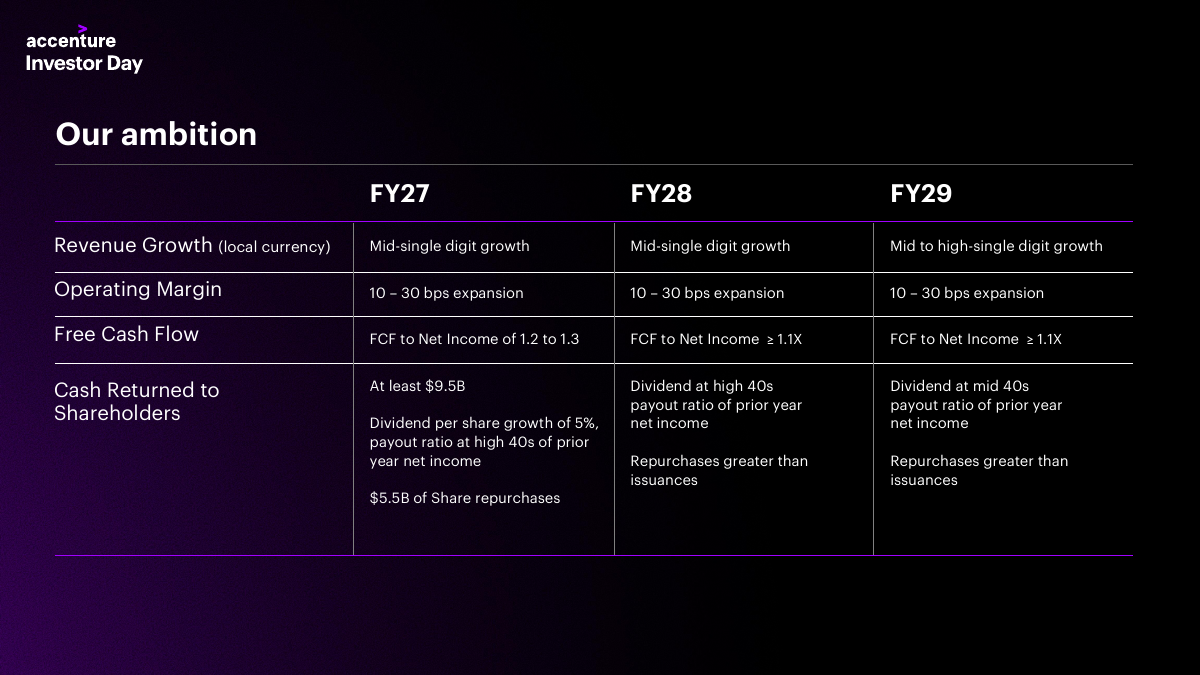
Chair and CEO Julie Sweet set out a three-year financial ambition of at least mid-single-digit revenue growth in constant currency in FY27 and FY28, followed by a step-up to a range of mid-single-digit to high-single-digit growth starting in FY29, while taking market share throughout the period. The ambition also includes expanding operating margin by 10 to 30 basis points in each of FY27, FY28 and FY29 while investing at scale, and returning cash to shareholders with free cash flow of at least 1.1 times net income. Sweet said: "We wouldn't have given this guidance probably a year ago," and explained that Accenture has spent four years building a new foundation and now has enough AI projects behind it to judge the pace at which clients move from pilot to production.
CFO Angie Park gave the arithmetic beneath the FY27 range: at the midpoint, implied organic constant-currency growth is approximately 2% to 2.5%, and at the top end 3.5% to 4%, with the inorganic contribution for FY27 estimated at roughly 2% to 2.5%. The ambition takes into account that Accenture will be absorbing AI efficiencies in its own delivery while delivering that growth. Sweet said clients will take time to scale AI across the enterprise, that the macro environment is contributing to a challenging spending environment, and that Accenture is "not waiting for a meaningful tailwind," although it expects some normalization over the next three years.
The FY29 step-up rests on two engines: the core, 94% of FY26 revenue and growing approximately mid-single digits, and the network of businesses, 6% of revenue and growing double digits, which Sweet said has the potential to double its share by FY29. Asked by an analyst from William Blair what would carry growth from mid-single digits in FY28 into the higher range in FY29, Sweet said the drivers are the core continuing to grow mid-single digits and the network doubling, together with where Accenture expects AI to scale by then, and that the company will say closer to the time where in the range it expects to land.
Margin: four levers, and revenue growing faster than headcount
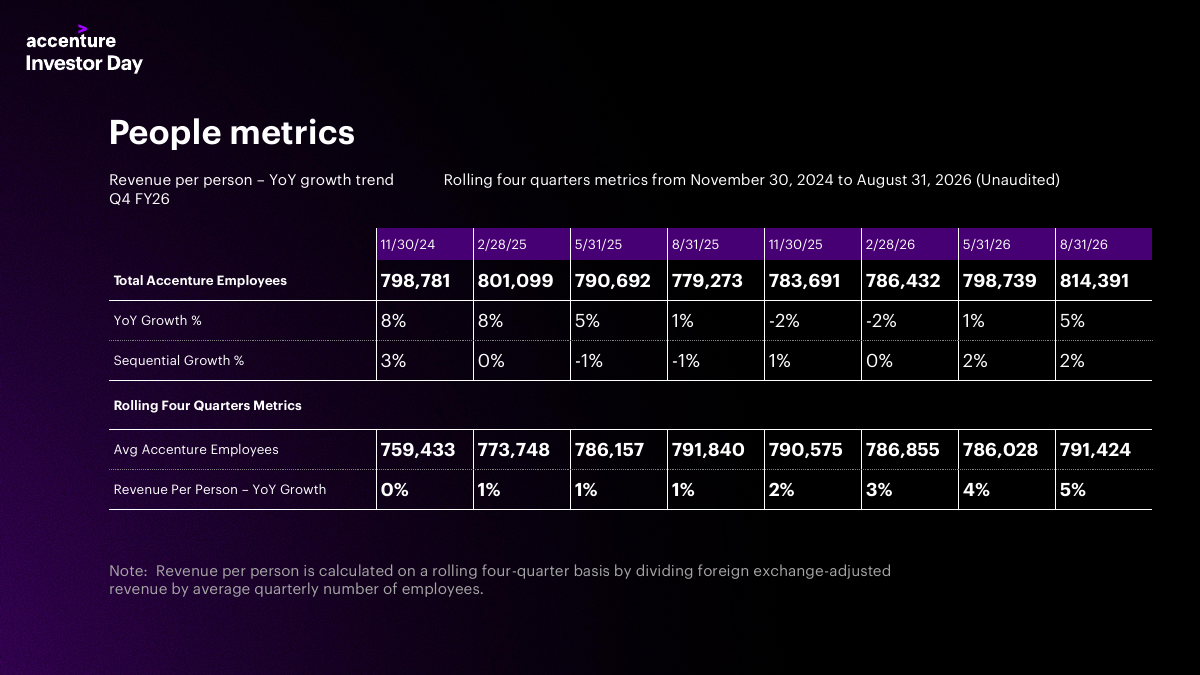
Park said the margin model is designed to create investment capacity and expand margins at the same time, using four levers: pricing and contract profitability, how Accenture delivers for clients, how it runs itself, and supply and demand management. Pricing is defined as the margin on the work sold; the goal is to maintain and improve it, and the FY27 margin expansion "reflects continued competitive intensity". Revenue per person increased approximately 5% in FY26, measured on a rolling four-quarter basis using FX-adjusted revenue over average quarterly headcount, and Accenture's goal is for it to improve again in FY27 by growing revenue faster than headcount. Over the last four years the cost of corporate functions as a percentage of revenue has been cut by more than 200 basis points, with the savings reinvested, and the next example is an agentic contract-to-cash process that touches 9,000 clients, 60,000 contracts and 900,000 invoices. Utilization of 93% creates operating leverage, and Accenture is deploying AI to match skills and capacity with demand and to shorten recruiting times.
Efficiencies from AI-enabled productivity will be used in three ways: passing value to clients, reinvesting the majority of what Accenture retains into growth, and expanding operating margin every year. Asked by an analyst from Wolfe Research about the conviction behind 10 to 30 basis points several years out, Park said the four levers are in play while the company absorbs significant investments, and Sweet added that Accenture's confidence comes from having operated for four years in an environment of more competitive intensity, giving more productivity to clients and reinvesting corporate-function savings. Key operating investments across learning, R&D and acquisition costs totalled $13.0 billion over FY23 to FY26, including $3.3 billion in FY26, alongside 60 basis points of adjusted operating margin expansion and a 7% adjusted EPS CAGR over the same period.
Capital allocation: $9.5 billion to shareholders and about $8 billion of acquisitions in FY27
Park expects FY27 free cash flow of $11.0 billion to $11.8 billion, a free cash flow to net income ratio of 1.2 to 1.3, and a return of $9.5 billion to shareholders, which she said represents 75% of operating cash flow, comprising a 5% increase in the dividend per share and $5.5 billion of share repurchases. Accenture expects the repurchases to reduce its weighted average share count by approximately 3%, and is evolving its mix toward buybacks because they support EPS and give more flexibility "in the context of the current valuation environment". Through FY29, Accenture expects a free cash flow to net income ratio of at least 1.1, dividend growth with a payout ratio in the mid to high 40s percent of prior-year net income, and repurchases greater than issuances. The payout ratio is set at the high 40s percent in FY27 and FY28 and the mid 40s percent in FY29.
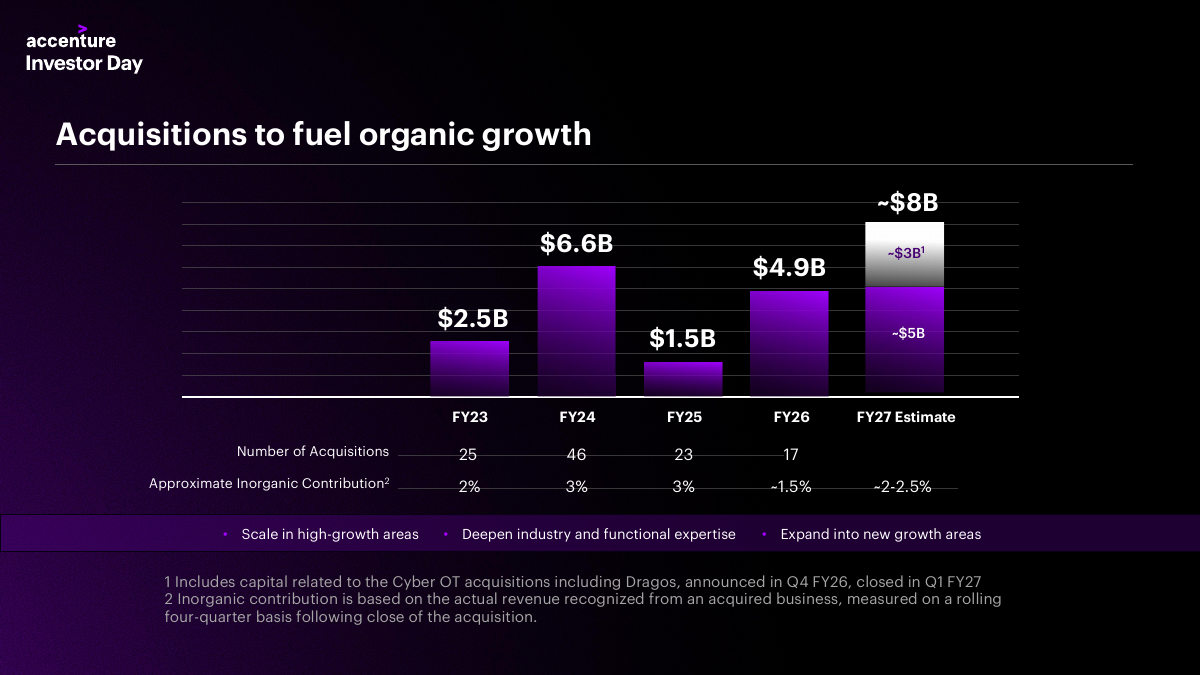
Accenture intends to keep investment-grade credit ratings and gross leverage below two times; in addition to roughly $3 billion for the cyber OT acquisitions, it expects to deploy a further $5 billion on acquisitions in FY27, at which level gross leverage would be about one turn. Park said: "And as always, if we see the opportunities to do more, we can". Acquisitions that extend core services capabilities must earn returns meaningfully above the cost of capital with a path to accretion over a relatively near-term horizon; those that expand the addressable market into products, platforms or solutions carry a higher return threshold and a longer horizon. The acquisition portfolio of the last three years is generating returns of more than two times the cost of capital, the Capital Committee reviews each deal semi-annually for three years against its business case, and Accenture exits businesses, offerings, countries and contracts that no longer meet its thresholds. Over FY23 to FY26 the company deployed $18.7 billion of acquisition capital and returned $34.8 billion to shareholders. An analyst from BNP Paribas Exane asked whether the move from 1.2–1.3 in FY27 to at least 1.1 in later years signalled a change in the business model, and Park said there was "nothing to read into that," that 1.1 is the minimum ambition and that investment levels will fluctuate.
Doubling the addressable market to $3 trillion
Sweet said that over the last four years Accenture has increased its addressable market from $1.5 trillion to $3 trillion, built the largest AI and data workforce in its industry, added $12.6 billion of revenue, grown at more than twice the rate of its investable basket and returned $35 billion to shareholders. Manish Sharma, chief strategy and Reinvention Services officer, gave the addressable market arithmetic: a $1.5 trillion base, plus $700 billion from 20 new growth arenas, makes a $2.2 trillion core, and $800 billion for the network of businesses takes the total to $3 trillion. Sweet described three strategic moves behind this: pursuing large-scale reinventions, with clients booking $100 million a quarter rising from 100 in FY22 to 141 in FY26 and Diamond clients from 267 to 317; taking an early position in AI, with a $3 billion three-year investment, more than 18,000 advanced AI projects and AI and data professionals growing from 40,000 to nearly 110,000; and using acquisitions, about $19 billion over four years including deals that closed in September, to move into higher-growth markets. A year earlier Accenture created Reinvention Services and has since set up seven Reinvention Partners, which Sharma described as units organized around the key budget holders in an enterprise.
Sharma said the core's biggest growth driver will remain large-scale reinventions, and gave four illustrations. In the digital core, ERP modernization is only 41% complete, only 28% of workloads have moved to the cloud, and sovereign cloud is already a $215 billion market. Managed services, 50% of the business, grew 7% in FY26 by Sharma's account, which Sweet later clarified as 7% in the fourth quarter and 6% for the year; security managed services is a $58 billion addressable market growing at 12% and AI and data managed services a $110 billion market growing at 15%. The enterprise AI stack is a $500 billion addressable market, and the number of data- and AI-led deals of $50 million or more has gone from four in FY23 to 50. Among the 20 AI growth arenas, the agentic commerce pipeline went from zero in January to $1 billion with $125 million already won, and software-defined vehicles has a $600 million pipeline. Accenture has invested almost $1 billion over four years in Reinvention.AI, its platform for agentification and automation.
Lan Guan, chief AI and data officer, described the enterprise AI stack as the "industrial kitchen" needed to scale AI, a seven-layer structure of data, knowledge, models, agentic core, governance and safety, AI operations and user front-end on top of infrastructure, and said the work is durable because new technology must keep being integrated and the stack must be run continuously. Guan said research with Sharma found only 10% to 20% of enterprise workflows justify frontier-model capabilities, and that Accenture launched full-lifecycle services for onboarding, managing and running open-weight models in secure environments a few weeks before the event.
Sweet said Accenture will also grow by who it sells to: the mid-market is a $240 billion market growing high single digits, was about 8% of Accenture last year, and from FY27 the company is going after it intentionally, after buying mid-market-focused companies over the last couple of years to test the strategy. John Walsh, CEO of the Americas, defined the mid-market as companies of roughly $300 million to $3 billion in size, to be served with ecosystem partners, packaged solutions and a custom-built team, and said Accenture is separately targeting the highest-performing emerging large enterprises of about $3.5 billion to $7 billion.